The New Museum’s “The Bowery: Devil’s Mile” makes a persuasive case that the street’s history belongs inside the story of New York art. Its subject is a mile-long route that served as a Lenape trail, a fashionable suburb, the city’s first working-class entertainment district and, later, one of America’s best-known skid rows. The exhibition’s strongest idea is that the Bowery’s cultural life was never separate from its rougher public image: entertainment, poverty, commerce and artistic experiment repeatedly occupied the same blocks.
That history gives the museum a particular role in the show. The Bowery once hosted concert halls, sideshows, beer gardens, Yiddish theaters, nickelodeons and jazz clubs, among other businesses and gathering places. The New Museum now stands within that continuing mix. The exhibition suggests the institution is part of the street’s history rather than a clean break from it—a useful lens for a neighborhood whose identity has always depended on what happens in its public spaces.
From street archive to entertainment district
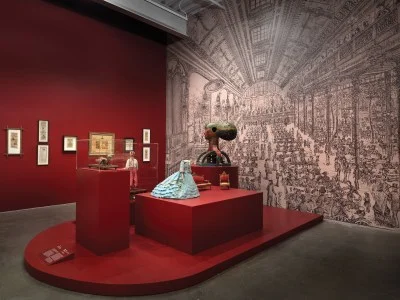
The exhibition begins with objects that could anchor a conventional local-history display: old maps, prints and a marble milestone roughly 200 years old. A portrait of Peter Stuyvesant, the combative director-general of New Amsterdam, shares space with an image of Five Points, the notorious neighborhood just west of the Bowery. The latter, based on a 1827 print by George Catlin, depicts the crowded district as a teeming urban scene. Its afterlife extends beyond the gallery: the image appeared on the cover of Taylor Einbinder’s 2001 history Five Points and helped inform the look of Martin Scorsese’s 2002 film Gangs of New York.
From there, the show builds its account through the printed matter of city life. News images of fires and riots sit alongside tickets, handbills, postcards, stereoscopic photographs, broadsides and songbooks. Advertisements for the dime museums and variety theaters that lined the Bowery between Chatham Square and Cooper Square make the street’s entertainment economy visible in its own promotional language. Much of the historical material comes from the New York Public Library; more sensational paper artifacts come from local archivist Adam Woodward’s collection.
Woodward also supplied one of the exhibition’s most striking objects: a decorated 1836 pump wagon used by the volunteer firefighters of the Lady Washington Engine Company No. 40. Its significance becomes clearer later, when it meets a different kind of civic artifact in the final gallery. The wagon’s presence ties neighborhood infrastructure to the show’s broader portrait of a place where communal identity took shape through work, spectacle and self-representation.
Who gets to represent the Bowery?
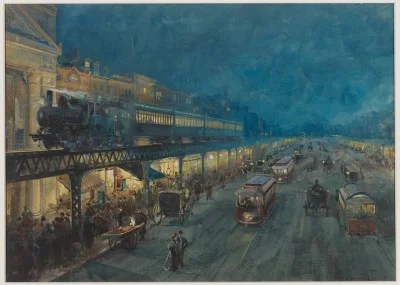
The show’s historical sequence also raises a sharper question: what does it mean to document poverty? A ten-minute slideshow of Jacob Riis’s photographs of immigrant families in cramped housing, paired with passages from his 1891 book How the Other Half Lives, faces Martha Rosler’s 1970s photo installation The Bowery in two inadequate descriptive systems. Riis used images and text to expose living conditions. Rosler’s work presses on the limits of that kind of representation.
Rosler’s installation contains no people. Instead, 45 silver photographs show storefronts and gutters, often strewn with empty bottles. Placards offer slang terms for intoxication in place of conventional captions. The arrangement invites viewers to consider how a neighborhood gets described—and what those descriptions leave out. Yet Riis’s forceful images dominate the encounter. The juxtaposition is thought-provoking, though the emotional weight of the earlier documentary work can make Rosler’s more analytical challenge harder to register.
Film is a conspicuous gap in the exhibition’s account. Its only moving-image work is Edwin S. Porter’s 1902 comedy How They Do Things on the Bowery, in which an out-of-town visitor is drugged and robbed in a saloon. Lionel Rogosin’s 1956 hybrid documentary On the Bowery is absent. That omission leaves a notable piece of the street’s screen history outside the gallery, even as the exhibition’s photography offers a rich view of how the Bowery has been observed.
A long gallery brings together work by WPA-era photographer Berenice Abbott, photojournalist Weegee and younger street photographer Harvey Wang. Reginald Marsh’s 1953 painting The Bowery Strokey’s Bar adds a ghostly note: a newspaper rests on the pavement beneath the headline “Atom Bomb Burns Out Ghost Town.” The picture captures a street seen through the pressures of its era, at once local and caught up in wider anxieties.
Personal memory becomes part of the exhibition
The gallery’s later material turns from observation toward participation. David Gadis’s photographs of CBGB in the late 1970s lead into a room devoted to Nan Goldin’s The Ballad of Sexual Dependency (1979–96). The slideshow, accompanied by a selected soundtrack, centers on candid portraits of friends, many made in Goldin’s Bowery loft. The images remain strikingly intimate: their immediacy carries the feeling of a record made within a social world, while their retrospective quality gives them a note of mourning.
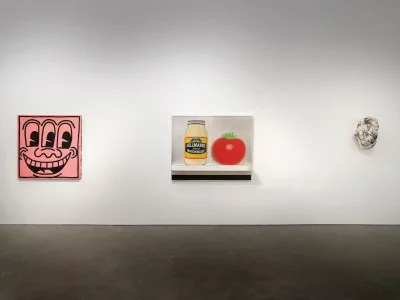
Across from Goldin’s work, 28 portraits by Billy Sullivan create a second, contrasting gallery of personal records. The pairing is among the exhibition’s clearest curatorial choices: two artists’ portraits make the Bowery legible through relationships and lived experience, rather than through street scenes alone. Works by Lynda Benglis, Eva Hesse and Tom Wesselmann, associated with their Bowery lofts, extend that connection between the neighborhood and artistic practice.
The final gallery gathers these strands around Brad Kalhammer’s Bowery Nation (1985–2012). The large assemblage combines 22 bird forms with perhaps a hundred kachina dolls made from found objects and refuse, arranged along a 25-foot wooden plank supported by sawhorses. Like the old pump wagon, it is a civic object built from materials and forms that carry local associations. Its scale and scrappy construction give physical shape to the exhibition’s sense of neighborhood pride.
A neighborhood told through its contradictions
“The Bowery: Devil’s Mile” is compact, and its mostly chronological approach can make its transitions feel orderly for a street defined by collisions. Still, the exhibition’s best moments come when objects connect across eras: a firefighting wagon beside an assemblage made from castoffs, or documentary photographs beside an artist’s critique of how poverty is pictured. The show understands that the Bowery’s history cannot be reduced to a single identity—bohemian refuge, working-class playground, skid row or art district.
That multiplicity is also what gives the exhibition its civic warmth. Its account makes room for famous artists and anonymous makers, entertainment venues and missions, printed souvenirs and images of hardship. Broadway may draw tourists and celebrities; the Bowery’s claim is more intimate. New Yorkers have their own points of connection to it, through family histories, work, art and the institutions that have occupied its blocks. The New Museum’s show leaves the street in motion, with its past still present in the cultural life unfolding there now.