Cringe is more than embarrassment with an internet vocabulary. It’s the bodily cost of realizing that a social agreement you thought you shared has just fallen apart. Kristoffer Borgli’s The Drama (2026) makes that rupture hard to ignore: about 20 minutes into a screening, I was curled into my seat, jaw tight, shirt collar pulled up toward my eyes. Nothing grotesque was happening. A group of friends was talking.
That reaction surprised me. I’ve written about Geko vomiting into Tess’s mouth in Lukas Moodysson’s A Hole in My Heart (2004), and felt at home with Judy Chicago’s menstrual defiance, Ina Poppe’s cheese made from her mother’s milk, Martin von Ostrowski’s semen-splattered canvases, and Marc Quinn’s sculpture cast from ten pints of his own blood. Florentina Holzinger’s waste-processing, piss-wallowing Seaworld Venice at this year’s Austrian Pavilion? Also my kind of thing. The body’s mess doesn’t faze me. Social exposure does.
There’s a familiar word for that feeling. Philosophers have a framework for it, too: cringe brings shame and sympathy into contact. It’s an old experience in a very current idiom.
Two people inside one wince
Shame is the older half of the story. Its root means “to cover,” and the feeling can involve guilt, disgrace, punishment, nakedness, or the exposure of something meant to stay private. Andrea Büttner’s 2022–25 serigraphs take up public humiliation; Jenny Saville’s sharply angled 1993 painting Plan makes vulnerability a matter of how a body is seen. Tracey Emin’s 1995 Everyone I Have Ever Slept With 1963–1995 and Martine Syms’s diaristic 2020 photobook Shame Space turn disclosure itself into a subject.
Shame makes you feel exposed, then pushes you to hide. Sometimes the wish to disappear can feel absolute: “dying of shame” isn’t always just a figure of speech.

Sympathy entered the philosophical discussion later. In The Theory of Moral Sentiments (1759), Adam Smith argues that imagination lets us approach another person’s feelings by picturing ourselves in their position. His “impartial spectator” imagines what we would feel “if we were” there: “We conceive ourselves enduring all the same torments, we enter, as it were, into his body, and become in some measure the same person with him.” Smith’s point is ethical as well as descriptive. We can feel with other people, and we have a duty to try.
Cringe is where those two responses meet: shame felt through someone else. Vicarious embarrassment. Mortification by proxy.
Languages around the world have their own names for it. Dutch calls it plaatsvervangende schaamte, or substitute shame; French has gêne par procuration, discomfort by proxy; and German uses Fremdschämen, foreign shame. Swedish speakers have the skämskudde—a “cringe cushion” to hide behind when, for instance, a breakdancer fails on global television. Japanese mite irarenai describes being unable to look at something distressing, awkward, or disastrous. Chinese slang offers a more dramatic diagnosis: gāngà’ái, or embarrassment cancer.
Online, “cringe” has become a handy insult, and that’s where the feeling gets mean. The policing of cringe can fuel harassment and give contempt a platform. Queer people, neurodivergent people, people under economic pressure, and people who are socially isolated are especially exposed to having their interests, efforts, or very presence dismissed as pathetic.
Taylor Swift told graduates receiving her honorary degree in 2022 to “learn to live alongside cringe.” That advice may suit an earnestness that gets read as charmingly awkward when it comes from a pretty white pop star. For many other people, the consequences of being called cringe are harsher. The sentiment may be generous; its reach is limited.
Even among friends, the label is a small act of censorship. Gen Alpha can call Hamilton cringe, while millennials dismiss “skibidi toilet rizz” as nonsense. The generational exchange gets old fast. Each cohort tends to find the next one’s slang ridiculous and the previous one’s politics naive.
The body keeps score
There’s a serious aesthetic feeling underneath the online put-down. Like disgust or horror, cringe acts on the body. Disgust takes its cue from “dis-taste,” the urge to spit something out; horror comes from the Latin horrere, to bristle. “Cringe” traces back to Old English cringan: to yield or fall, as in battle, and eventually to crouch in fear.
Disgust may seize the stomach and horror raise the hairs at the nape. Cringe tightens the face: eyes narrowed, mouth half open, watching and trying not to watch at once. Its signature wince arrives fast, but duration changes the experience. A humiliation that keeps going, or an awkward moment that slowly reveals how much worse it can get, makes the discomfort accumulate.
What counts as cringeworthy depends on the viewer, but not entirely. Like obscenity, it can feel obvious until someone else reacts in the opposite way. Then the discomfort shifts: perhaps you’re turned on by something another person finds repulsive, or repelled by what they find arousing. Either way, you may feel exposed by your failure to read the scene as they do.
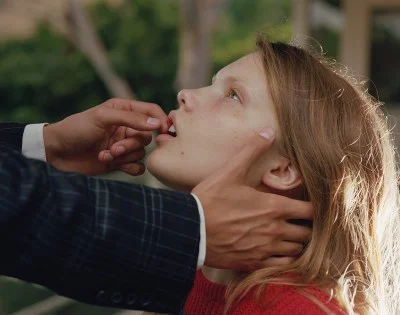
Torbjørn Rødland’s luminous photograph This Is My Body (2013–15) makes that uncertainty especially painful. A girl’s head tilts upward in the hands of an adult man; his fingers touch the edge of her mouth. Is the image showing pleasure or brutality? We can’t tell, and the discomfort includes the recognition that we may not know how to interpret what we’re seeing.
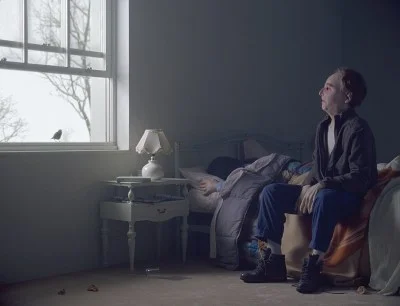
Diego Marcon’s video The Parents’ Room (2021) puts the viewer in a similar bind. A man in a prosthetic mask sings about killing his wife and children, then himself. The performance swings among horror, absurdity, and painfully earnest melodrama. Should we laugh or grieve? The question is part of the distress.
Jordan Strafer’s trilogy—Loophole (2023), Decadence (2024), and Talk Show (2026), shown at this year’s Whitney Biennial—raises another difficult question. The works deal with trauma and sexual assault, while their performances push past even familiar melodramatic conventions. The viewer may find themselves wondering, uncomfortably, whether the people giving testimony deserve compassion.
One viewer’s cringe can be another’s pleasure. If you believe you have nothing in common with the person being humiliated, you may enjoy their discomfort: that’s schadenfreude. Sympathy works in the other direction. Find some basis for recognizing yourself in them, and their humiliation starts to feel like yours.
Aristophanes described love as the soul recognizing its likeness in another. Shame follows a similar logic. To cringe is to recognize someone—and to learn something about whom you count as one of your own.
That gives the feeling a political edge. Cringe reveals who we think we share a world with. It’s an aesthetic reaction that exposes the ethics behind our sympathies.
When the social contract breaks
Not every disturbing artwork produces cringe. Damien Hirst’s A Thousand Years (1990), with its severed cow’s head and maggots that become flies inside a vitrine, may turn a viewer’s stomach. But the work doesn’t depend on the precarious social bond that makes cringe sting.
Cringe is interpersonal. You might feel ashamed of your teenage poetry years later, but cringe is bound up with the fear that other people will reject you. It asks, in effect: How do they see me? A joke? Talented? A freak, a threat, a sex object? The boss who thinks he’s a “chilled-out entertainer”? The singer wondering, in Rod Stewart’s words, Da Ya Think I’m Sexy? Do you think I’m cool?
The Drama builds its crisis around that question. At dinner, a woman sits with her fiancé and close friends as everyone takes a playful turn naming the worst thing they’ve ever done. She thinks the group shares a common standard for what can be confessed. When she offers her own story, she discovers that her vulnerability belongs to a different category. Instead of drawing the group closer, it marks her as an outsider. The film lets that mistake shatter every relationship on screen.
Watching can expose you, too. If another cinema-goer sees you recoiling—or a reader learns what makes you recoil—you’ve disclosed your own limits. Cringe begins as secondhand shame and ends as a firsthand confession.
My personal Room 101 is that instant when I realize, halfway through saying something, that I’ve mistaken what we understand each other to mean.

That gap between how we see ourselves and how other people see us makes cringe art a kind of performance art. The tradition runs through 1970s body art—Marina Abramović and Vito Acconci as its Plato and Aristotle—Andy Kaufman’s anti-comedy, and Viennese Actionism. In the 1980s and ’90s, Sarah Lucas and the sick aesthetics of Paul McCarthy and Mike Kelley carried the thread. Kelley’s 1987 Three Point Program/Four Eyes included the glorious banner “pants shitter & proud p.s. jerk-off too (and i wear glasses).” Ryan Trecartin later became a manic heir to this trash-culture line, adapting it to a hyperperformative age.
Television brought a version of that discomfort to a wider audience. In the 2000s, “cringe comedy” became a recognizable mode in shows including Curb Your Enthusiasm, Da Ali G Show, the UK The Office, and Peep Show. The following decade produced a feminist answer in The Comeback, Girls, Veep, Crazy Ex-Girlfriend, Insecure, and Fleabag.
Much of the force of older transgressive art—its silences, humiliations, and hostility between performer and audience—moved into popular culture. You could pair the Q-tip scene from Girls with Abramović’s Rhythm 0. Acconci’s canonical Seedbed, where he masturbated beneath a ramp while describing fantasies about visitors walking overhead, made gallery-goers unwilling voyeurs in 1972. Nathan for You and The Rehearsal let Nathan Fielder build a career from a related kind of involuntary looking.
Minor cringe, major cringe
Artists working now have taken up cringe’s expressive possibilities, but it helps to distinguish between two approaches. I’ll call the first minor cringe: art that considers cringe from a safe distance, without making the viewer wince. It’s meta-cringe, examining the feeling from outside.
Major cringe works from inside the feeling. It uses form and subject to make the viewer experience cringe directly—endo-cringe, saturated in the affect. Call it a Geschämtkunstwerk, if you like.
The distinction depends on the work, not the artist. Christine Tien Wang’s photorealistic meme paintings in her 2022 exhibition “Fake Stupid, queen of cringe” at Berlin’s Galerie Nagel Draxler were minor cringe. They surveyed network culture’s shame, snark, and anxiety from above, but left the viewer largely untouched.
Wang’s Starving Artist (2025) is harder to keep at a distance. Its painted computer screen holds several windows: a bitcoin investment spreadsheet, the spine of a James Joyce novel, a meme drawn from the film Challengers, and an archival photograph of a famine victim. By laboriously repainting a screen that places these images side by side, Wang forces a question about the moral consequences of algorithmic flattening. Historical suffering becomes another item in an ironic feed. The shame belongs to the platform—and to the people who keep looking. That’s major cringe.
Cringe is where sympathy and judgment collide. It isn’t just embarrassment at someone else’s performance; it’s the uneasy recognition that we’re implicated in the rules that make that performance feel humiliating. That’s why the difference between Amalia Ulman’s works matters. Her 2025 film *Magic Farm*, about an American crew trying to manufacture a viral trend in rural Argentina, turns the attention economy into a source of pleasurable, relatively minor discomfort. Her 2014 Instagram project *Excellences & Perfections* cuts closer: its online makeover story mixed a staged breast augmentation with Ulman’s actual extreme food restriction. The viewer can’t neatly separate fiction from harm, or observation from complicity. Self-representation has become so entangled with self-branding that there’s no clean place to stand outside the cringe. Humiliation is a kind of fall: *humilis* means “on the ground.” Much contemporary art about cringe dwells on the contortions women are asked to perform to meet ideals of beauty. The ideals look elevated; the bodies required to pursue them are pushed toward the grotesque. That tension ran through “Picture Perfect,” an exhibition at Bozar in Brussels from March to August of this year. Orlan, Sara Cwynar, Juno Calypso, and Haley Morris-Cafiero were among the artists challenging norms of representation by taking beauty apart. Their works make femininity look disgustingly cute, violently performed, and open to contempt whether it succeeds or fails. The point is not that beauty standards are merely unattainable. It’s that even apparent success can become its own nightmare. Marianna Simnett’s *Blue Moon* (2022), also on view, turns that nightmare into a shifting image: a glitching figure who plays the flute and evokes Athena, moving through teal and tawny hues. In one version of Athena’s story, she abandons and curses her flute after seeing her cheeks puff out as she plays. The myth makes a stark connection between fear of looking ugly and the loss of a talent. Sixteenth century BCE, meet 2026.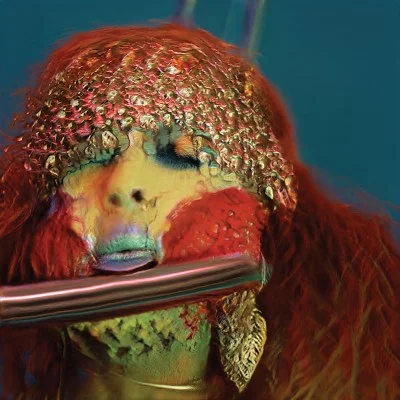
Blue Moon, 2022. Courtesy Société, Berlin
The internet turns need into a performance
Networked life constantly invites people to exhibit themselves, and the internet gives public humiliation a ready-made stage. It also lets us feel embarrassment by proxy. Elisa Giardina Papa’s 2011 video *need ideas!?! PLZ!!* gathers YouTube clips of young teenagers asking viewers to help them find ideas for their vlogs. One girl, introducing herself as PinkSummerCrush, says, “Hey uhm YouTube, it’s PinkSummerCrush, uhm… I wanted to start a web show and I need ideas for it but I don’t know, like, any ideas.” Another quietly asks for suggestions because she doesn’t know what to do.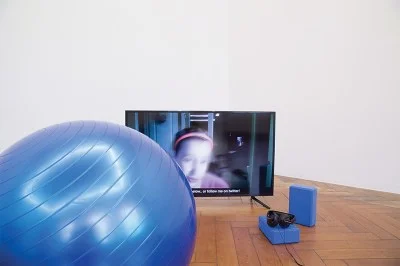
When the past becomes embarrassing
There’s another kind of cringe: the feeling that an artwork itself has become embarrassing. Some viewers might point to intentional kitsch in Neo-Pop, others to the Jay-Z and Marina Abramović collaboration. I’d nominate luxury-brand collaborations: the art world’s driest thirst trap. But embarrassment can tell us something about historical time. Nikki S. Lee’s “Projects,” made from 1997 to 2001, consists of photographs in which she moved among different social groups and subcultures. If you were around for the series’ heyday, you may remember its reception.