The Metropolitan Museum of Art’s “Krasner and Pollock: Past Continuous” makes a persuasive case that the history of Abstract Expressionism changes when Lee Krasner is treated as an artist in her own right. Its more than 120 works give the couple comparable attention, then follow the different paths their careers took. The result shifts the familiar story away from Jackson Pollock’s fame and decline toward the artistic decisions Krasner made across decades.
That adjustment matters because Pollock’s public image has long crowded out Krasner’s work. A May auction placed him in the $100 million club, and his biography has had a Pulitzer Prize-winning treatment and a Hollywood film. Krasner, played by Marcia Gay Harden in Pollock (2000), has often entered the story through her relationship to him. The exhibition challenges that framing by giving her work room to establish its own force.
Two artists, one shared history
The show opens with footage of the couple’s two-story house and studio on Long Island, where they lived for nearly 11 years. Historic images introduce Pollock and Krasner alongside their dog, Gyp, and a tamed crow called Caw Caw. The setting was more than a backdrop: it was where Pollock developed the drip paintings that would become his most celebrated work, far from New York and the Cedar Bar.
Pollock worked on canvas laid across the studio floor, pouring and flicking enamel and house paint with sticks and brushes rather than touching the surface. The exhibition also makes room for an influence often left outside the standard account: Ukrainian-born artist Janet Sobel (1893–1968). Pollock saw her Milky Way (1945) at Peggy Guggenheim’s Art of This Century gallery in 1946. The painting directly inspired his first drip painting, Galaxy, in 1947.
By 1949, a LIFE magazine headline was asking, “Jackson Pollock: Is he the greatest living painter in the United States?” Its images cast him as an isolated, brooding figure. Krasner barely registered in that public portrait. The Met’s account places that kind of mythmaking beside the evidence of a working relationship, making the imbalance visible without reducing either artist to the other.
Krasner’s work becomes the argument
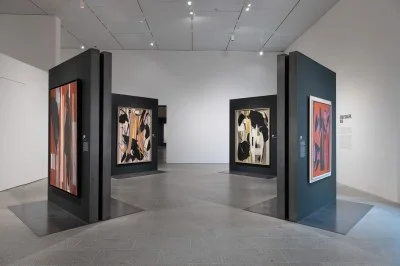
The exhibition’s sharpest curatorial choice is to begin with Krasner’s mid-1950s collages, made as Pollock faced an artistic impasse and his life spiraled. That sequence changes the emotional center of the show. Instead of treating her career as an appendix to his tragedy, it foregrounds a period when she was building a new visual language from the debris around them.
In Bald Eagle (1955), Krasner assembled pieces of dark brown linen and unprimed canvas that she and Pollock had discarded. A white shape near the center suggests a bird’s profile; within it, Pollock’s dripped black line remains visible. The painting turns shared studio material into a work with its own structure and meaning. Krasner’s use of what had been rejected becomes an act of transformation, not a footnote to Pollock’s practice.
Her approach wasn’t a single breakthrough followed by a settled style. The exhibition tracks an artist who repeatedly questioned her direction and found another way forward. Before meeting Pollock, Krasner had written lines from Arthur Rimbaud’s A Season in Hell on her studio wall:
To whom shall I hire myself out? What beast must I adore?
What holy image is attacked? What hearts shall I break?
What lie must I maintain? In what blood tread?
The verses suggest a useful lens for the work on view: Krasner’s career was marked by restlessness and a hard-won insistence on artistic independence. The show doesn’t frame that independence as a clean escape from Pollock. It presents their lives and working materials as entangled, while insisting that her achievements can’t be measured by his reputation.
A partnership without a supporting role
The Met also reaches back before they met, placing their early work together. Their self-portraits show two distinct sensibilities: Krasner’s graphite and crayon drawing from around 1929–30, and Pollock’s muddy brown, heavily worked image from around 1930–33. The gallery then turns to “American and French Painting,” a 1942 group exhibition curated by Russian émigré artist and theorist John Graham. Krasner and Pollock appeared alongside Stuart Davis, Willem de Kooning, Picasso and Henri Matisse. Krasner saw the show, learned Pollock’s name and sought him out.
Their relationship has been reassessed before. In 1981, curator Barbara Rose organized “Krasner/Pollock: A Working Relationship” to challenge the view of Krasner as a lesser artist and dutiful helpmate. Rose argued for a complex partnership between artistic equals, but the wider public story continued to revolve around Pollock. “Past Continuous” gives that argument greater weight by tracing Krasner’s development across the galleries, rather than asking a single comparison to overturn decades of attention.
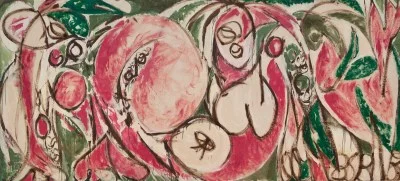
That focus is especially effective in the contrast between their late work. Pollock made a small number of singular paintings, including Portrait and a Dream and The Deep, both from 1953. Krasner continued to range outward. Her The Seasons (1957), nearly 17 feet long, uses abundant, sexually suggestive forms to return to the theme of renewal a year after Pollock’s death. The work’s scale and frankness resist the idea that her strongest art was merely a response to his.
A career built through change
Krasner’s later work makes clear how little she relied on one signature formula. Kufic (1965) is spare and contemplative; its title points to an early form of Arabic calligraphy and to her sustained interest in writing and linear marks. Rising Green (1971) offers another measure of her range. Across the two decades between The Seasons and her final monumental collage, the show finds an artist willing to change course rather than repeat a successful solution.
That last collage, Past Continuous (1976), incorporates charcoal figure drawings made while Krasner studied with Hans Hofmann. The exhibition closes with Future Indicative (1977), built from collaged figure drawings. These works put drawing, paint and collage into conversation across a career, while showing how Krasner returned to earlier material without simply repeating it.
Her 1955 Stable Gallery exhibition is recreated here, recalling the moment critic Clement Greenberg called her “a major addition to the American art scene of the era.” Greenberg later praised Pollock’s drip paintings as the first great American paintings and said Krasner had pushed collage into new American territory. The difference in emphasis captures the hierarchy she faced: recognition came, but the critical language around her work rarely matched the scale of his acclaim.
“Past Continuous” can’t erase that history, and it doesn’t need to. Its achievement is to make the imbalance harder to sustain. Krasner’s collages, large canvases and shifts in style show a career that stands on its own terms and resists easy comparison with her contemporaries. The exhibition leaves viewers with a fuller account of American art: Pollock’s work remains central, while Krasner’s can finally be seen at equal scale.