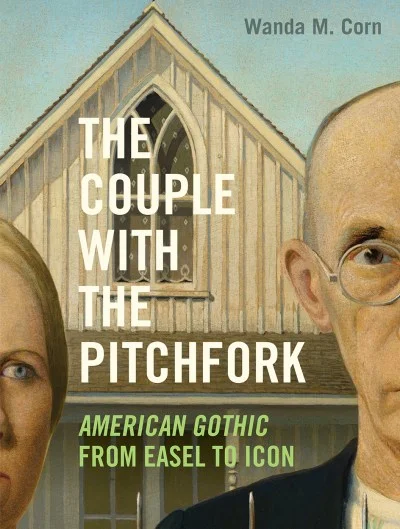
Grant Wood’s American Gothic has lasted because viewers can keep remaking it. In The Couple with the Pitchfork: American Gothic from Easel to Icon, art historian Wanda Corn argues that the painting’s familiar pair became a flexible template for ideas about marriage, identity and home. The image may look plainspoken, but its lasting appeal rests on a tension between its orderly design and the unease beneath it.
A Midwestern style takes shape
Corn has spent five decades studying the painting, which also connects with her own Midwestern family history. Her book includes a photograph of her Indiana grandparents: he wears denim overalls, while she stands beside him in a homemade dress, her hair pulled back. The resemblance to Wood’s figures points to how closely the 1930 painting draws on regional life. That connection alone, though, hardly explains its reach beyond the Midwest.
Wood, who grew up in Iowa, was looking for an artistic language rooted in the region. After experimenting with French Impressionism during trips to Paris and working as a decorator in Cedar Rapids, he turned toward forms he saw as distinctly Midwestern. Support for the arts was also growing in small-town America, aided by philanthropies including the Carnegie Foundation.
The painting’s structure reveals how carefully Wood built that language. Vertical elements, from the pitchfork to the church steeple, give the composition its firm order. Circles and ovals recur in the figures’ faces, the woman’s brooch, the dress pattern and the man’s ears. Wood called this quality “decorative”: a precise arrangement of lines and shapes that could be mistaken for simple realism.
A famous image built on a misreading
Wood said the figures represented a small-town father and daughter, modeled on his sister Nan and his dentist. The press instead presented them as a farmer and his wife, and audiences quickly read the painting as a portrait of marriage. That interpretation persisted despite Wood’s account—and despite complaints from Iowans that the pitchfork’s three tines were outdated, while critics struggled to place the work alongside modernist abstraction.
American Gothic won a prize at a juried exhibition at the Art Institute of Chicago. Its clean, geometric forms reproduced effectively in newspapers, helping the image spread. The painting’s immediate fame came with disagreement about what it meant. Corn sees that gap between the artist’s intention and the public reading as central to its endurance: the paired figures can stand in for many kinds of union.
From museum painting to shared template
Corn has collected hundreds of reworkings that show how far the image can travel. Artists and popular culture have recast the pair in butter at a state fair, as gay couples supporting same-sex marriage and as a feminist scene in which the woman leaves for work. The painting’s pose and recognizable props make it easy to adapt while leaving room for each version to change the story.
Some early adopters came from an unexpected quarter. Black urban artists who encountered the painting in Chicago in the 1930s saw Wood as a model of a self-taught artist from farm country. For artists such as Walter Ellison, reusing the arrangement of a couple outside a family home offered a way to tell stories about migration.
Corn traces the paired-figure motif through art history, from Egyptian princes and Etruscan terra cottas to Dutch Golden Age portraits. Wood rendered that archetype in a form that modern audiences could recognize, but his composition carries a strain those older examples don’t necessarily share. The book connects that tension to Wood’s likely homosexuality and the failure of his marriage five years after he painted American Gothic. Its controlled surfaces hold something unsettled—and that friction gives each new interpretation somewhere to begin.