For Star Trek Online’s community, Patrick Stewart’s death turned a familiar MMO into a shared place to grieve. Players gathered in orbit and at Starfleet locations to honor the actor who made Captain Jean-Luc Picard a defining figure in Star Trek: The Next Generation. The memorials were informal, assembled by people logging into the same persistent world for different reasons, but they gave fans a way to be present together as the news settled in.
Stewart died at 86 after what was described as a “brief and poignant journey with Alzheimer's Disease and Lewy Body Dementia.” The tributes followed another recent loss for Star Trek fans: Walter Koenig, who played Pavel Chekov. Star Trek Online, which launched in 2010 and is still running 16 years later, has become a meeting place for fans marking both departures. That role comes from the game’s setting as much as its age: it gives players recognizable Starfleet spaces where remembrance can take a visible, shared form.
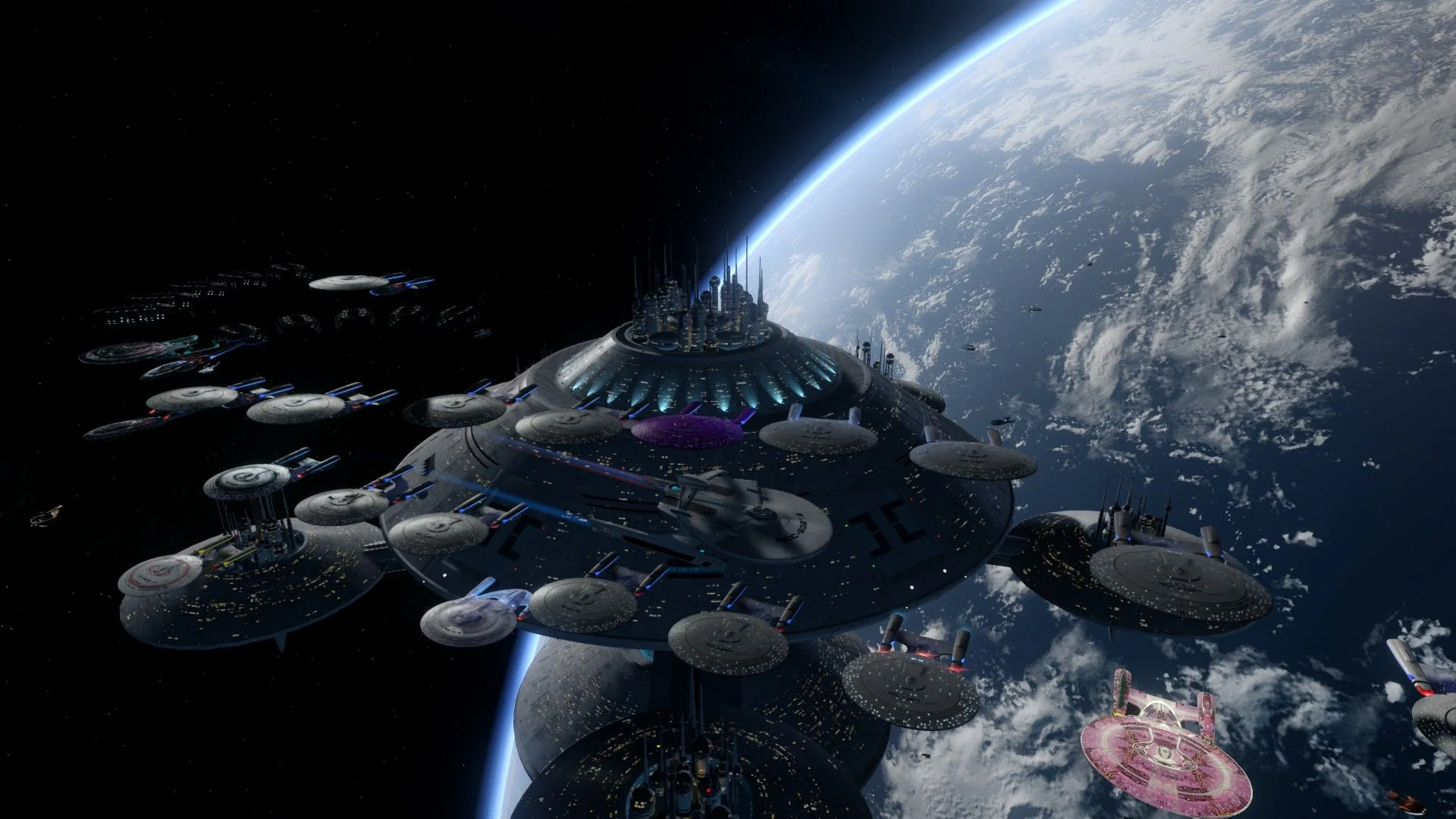
A fleet forms in orbit
In the Sol system, players had assembled Galaxy-class exploration cruisers—the same ship class as Picard’s USS Enterprise-D. Their vessels carried names including USS Remembrance, USS ForEverPicard and USS Champion. One captain took a looser approach with the USS Purple Enterprize. The fleet made the tribute legible at a glance: these weren’t generic ships passing through, but familiar vessels arranged around a character whose command of the Enterprise-D remains central to the series’ appeal.
At Earth Spacedock, the Federation’s in-game hub, players gathered around a Starfleet seal with torches raised. The game’s torch emote is intended for honoring “absent friends.” Multiple memorials ran at once across separate map instances; seven were full or close to capacity during the visit. That detail captures a practical feature of online gatherings: when one room fills, the same community can form elsewhere in the game, with the shared ritual repeated across instances.
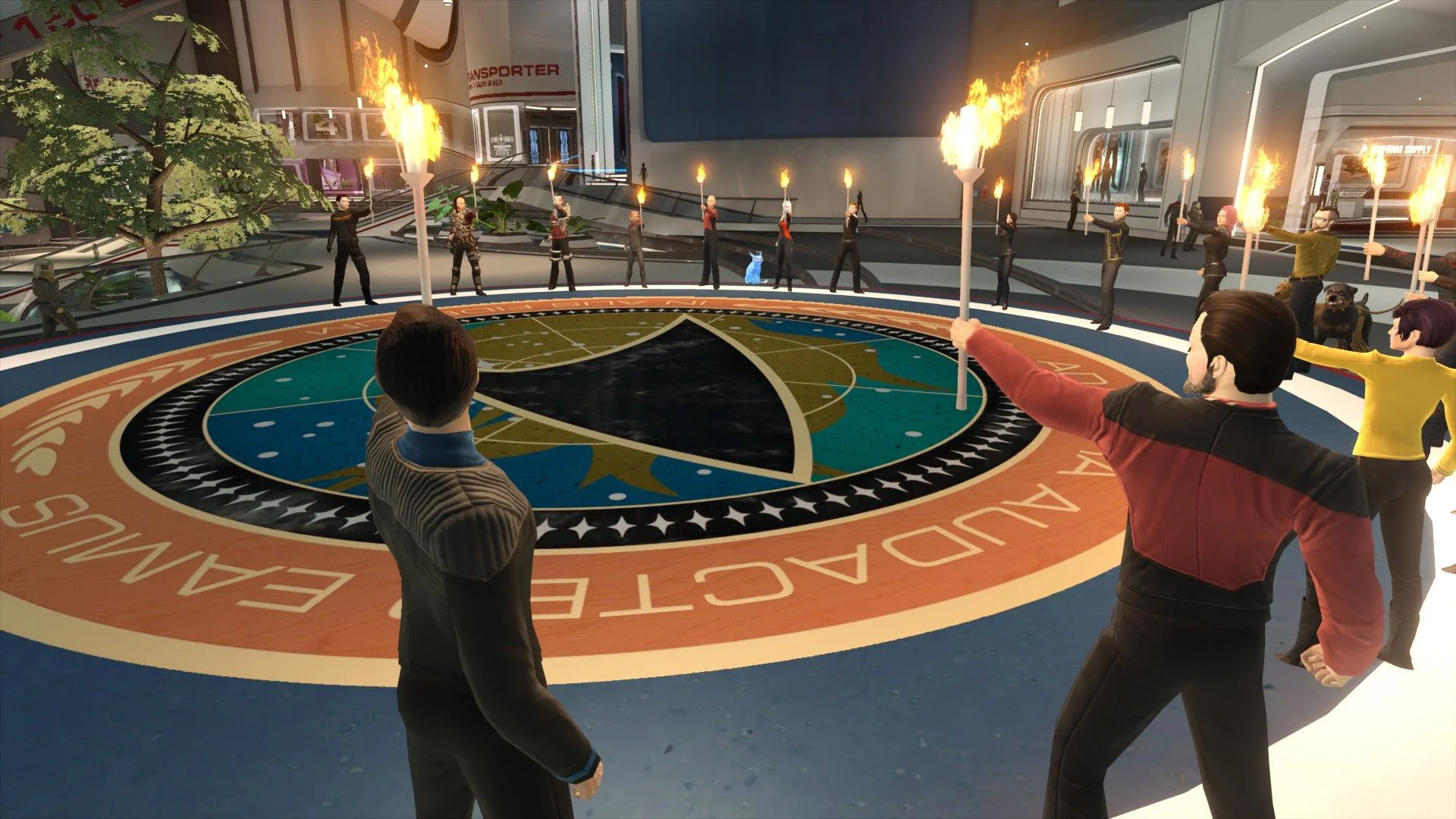
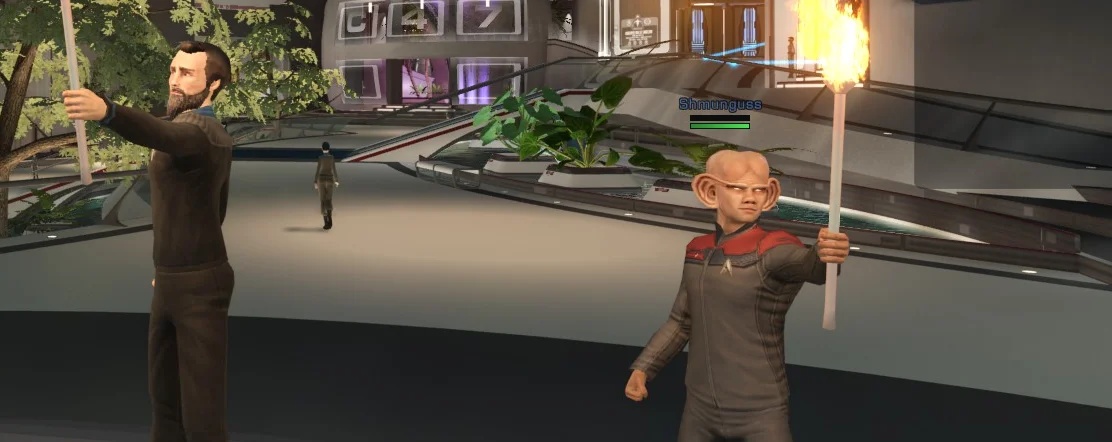
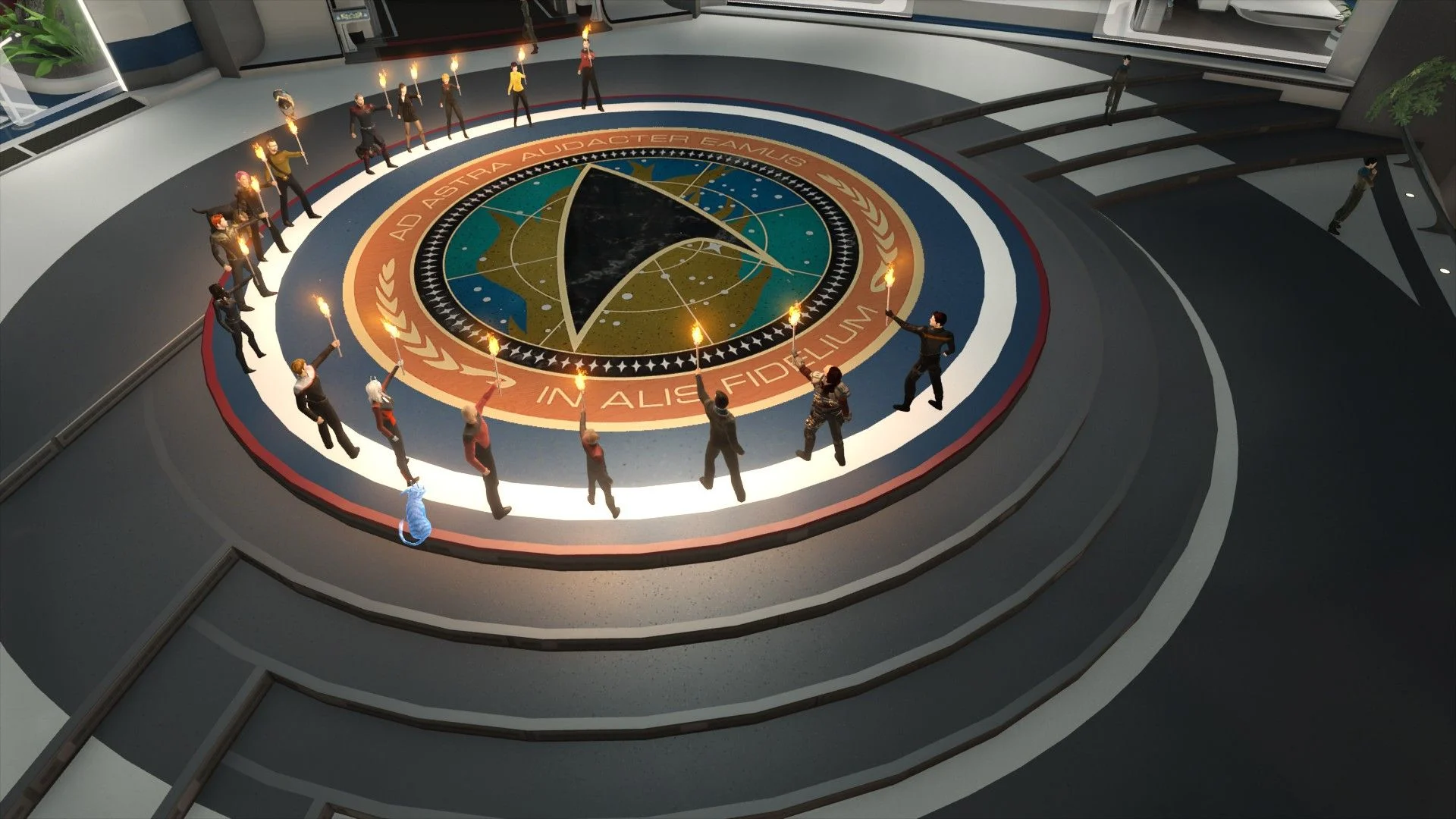
The gathering had the unpredictable texture of an MMO: a small Ferengi named “Shmunguss,” a zone-chat dispute about atheism, then a player offering the farewell, “may the Force be with you, Gandalf.” The odd turns didn’t undo the sincerity of the tribute. In a game chat, solemnity has to share space with jokes, disagreement and the ordinary noise of strangers trying to communicate; that mixture can make a memorial feel less like a staged ceremony and more like a community gathering as it actually is.
Picard at the Academy
Starfleet Academy drew its own crowds. At one gathering, a player using a Picard character stood quietly before the assembled fans, while others held torches, saluted or shared lines from Picard and Shakespeare. A Vulcan player cycled through emotes that conveyed grief. The text accompanying the emotes suggested the player was German. The scene drew on the game’s familiar visual language—uniforms, ranks, gestures and recognizable locations—to let people express a loss even when they didn’t have a shared spoken language.
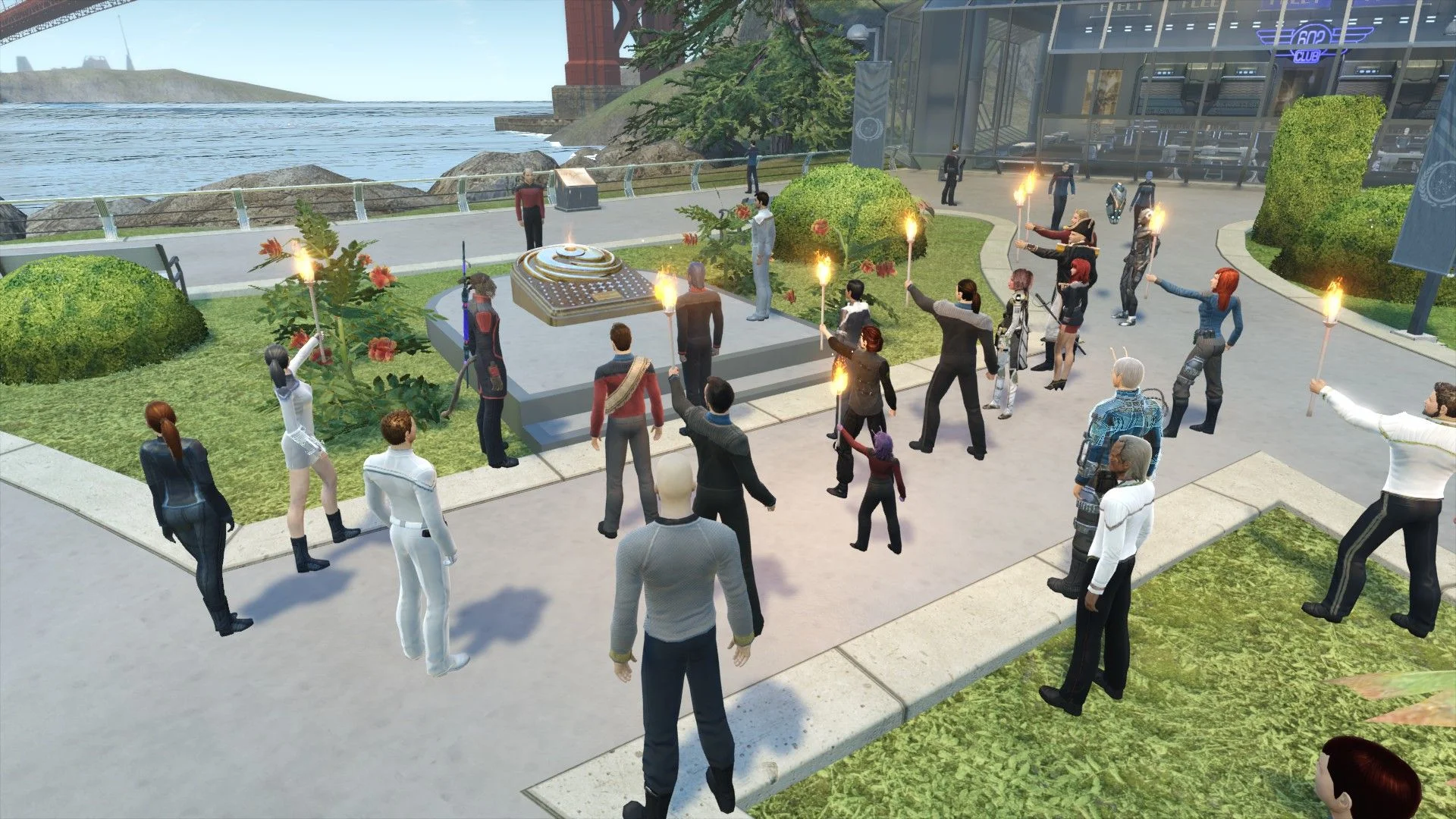
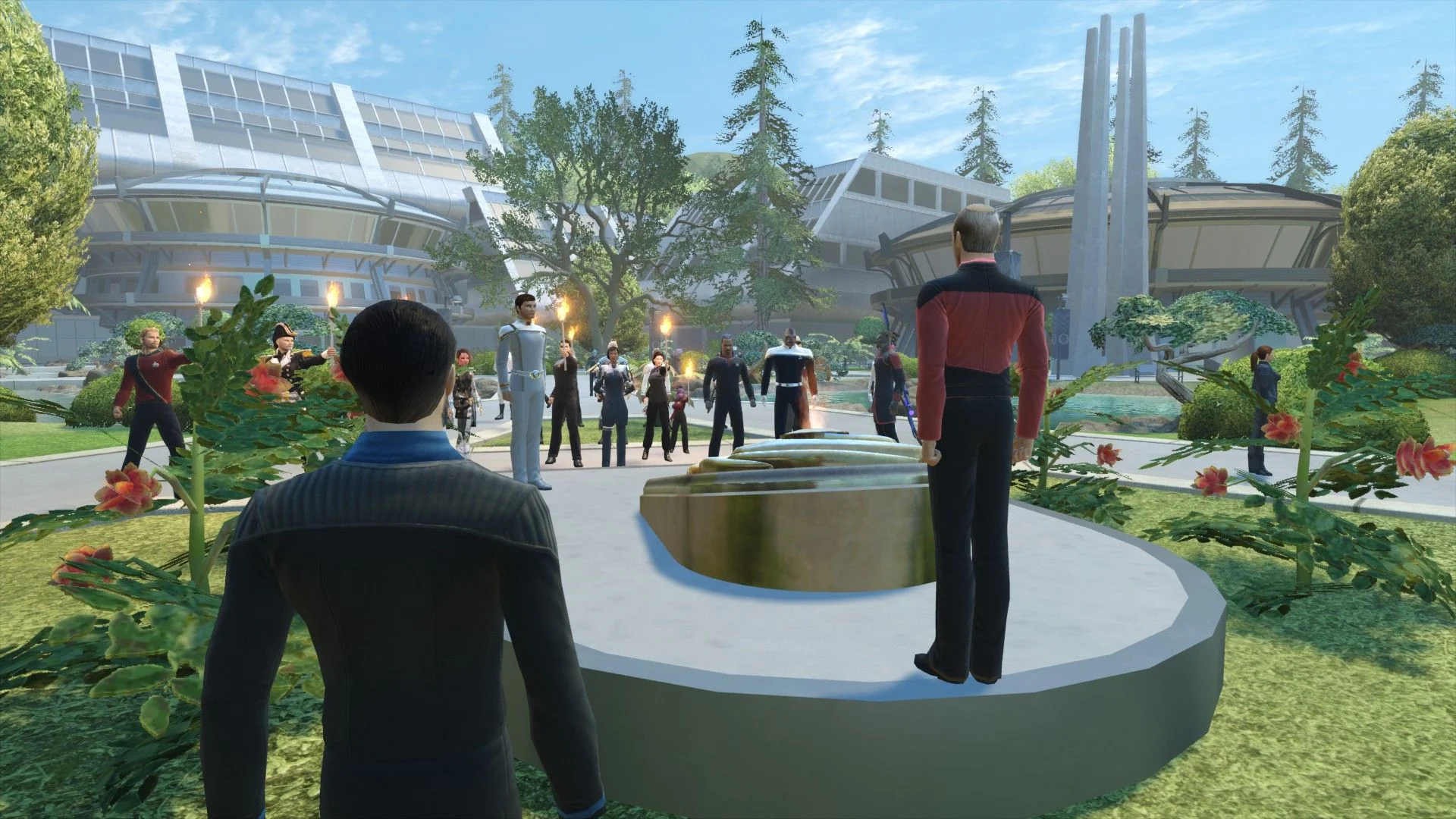
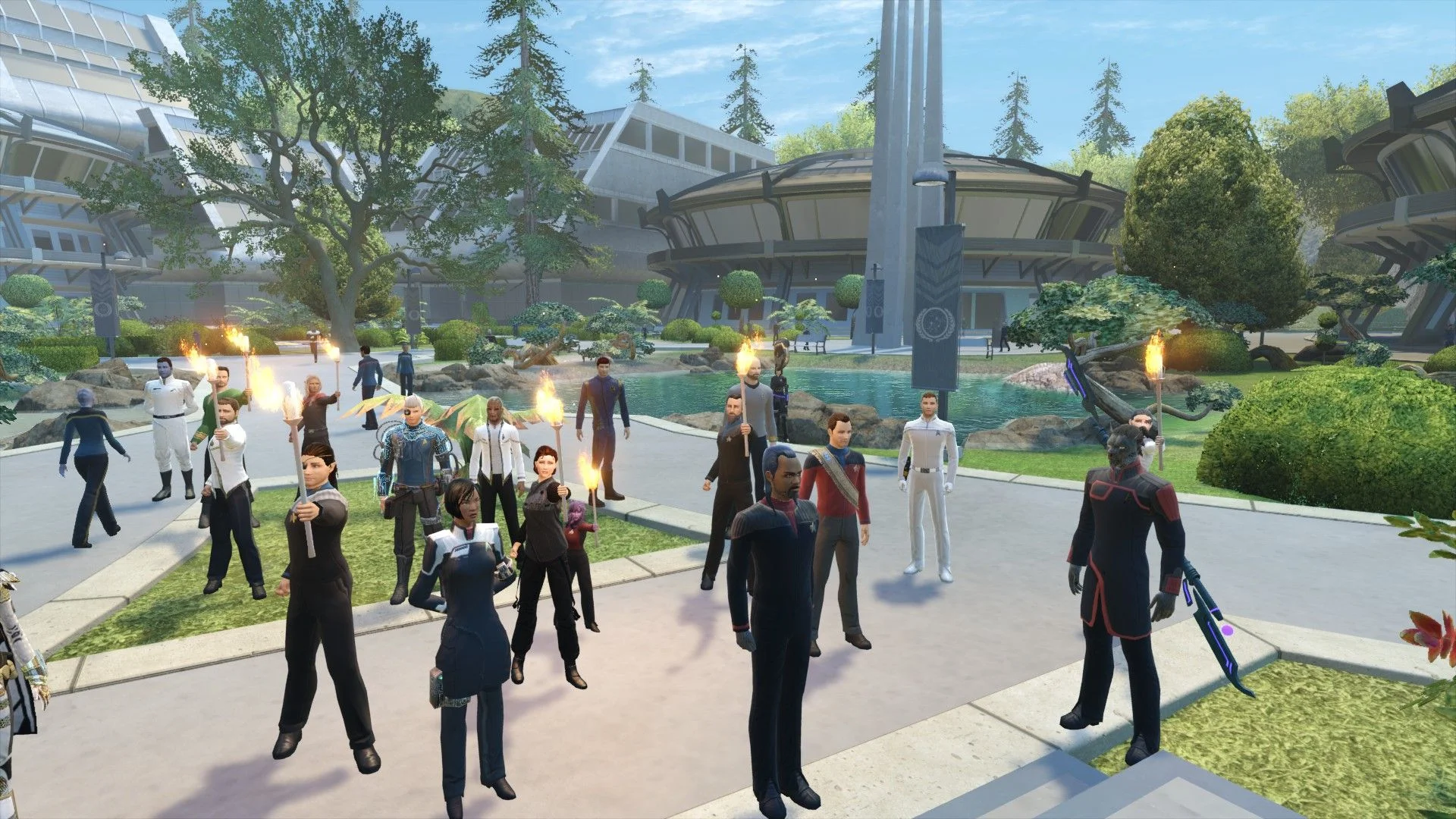
At rank 63, the Picard character hadn’t been created for this role. Still, the player stood as a quiet focal point for a crowd whose gestures and words gave the vigil its shape. The choice of character mattered less than the shared recognition: everyone understood who the figure represented, and the Academy provided a setting that connected the tribute to the fictional institution Picard helped make meaningful. A simple avatar, standing still among the crowd. That was enough.
What an online world can hold
Roughly 1,500 people were playing Star Trek Online on Steam at the time, and the memorials drew hundreds. The game may no longer top player charts, but these gatherings show what a long-running online world can offer beyond missions and combat: a place where fans can meet when a shared story loses one of the people who brought it to life. The numbers here are underwhelming as a measure of blockbuster scale, yet they describe a substantial gathering for a specific community with a clear reason to come together.
This is more significant than it looks. For players, the game’s maps and emotes turn a private reaction into something others can witness and answer; no central ceremony needs to be arranged for a crowd to form. If you're working in this space, the lesson is that a persistent game world can carry meaning its designers may not have planned for, because players already know how to inhabit it together. And yet, that meaning depends on the world remaining available and on people choosing to show up. Star Trek Online’s memorials offer no measure of what every fan felt, but they show a community using the tools it had to mark a loss.