Photo by Samuel Boivin/NurPhoto via Getty Images
Netflix’s engagement challenge may have a simpler explanation than the familiar calls for more prestige films, theatrical releases or weekly episodes: subscribers have fewer new titles to discover. After content chief Bela Bajaria and film head Dan Lin departed, advice on how Netflix should reinvent itself returned to three recurring prescriptions. But the available viewing and release data suggest those fixes may miss the more direct lever: the number of new shows and films landing on the service.
The debate has sharpened since Bloomberg’s Lucas Shaw calculated that Netflix’s total viewing hours grew just 2% in its semiannual Engagement Reports. Reports that subscribers are opening the app less often and spending less time there have added to the concern. For a service judged in part by how much people watch, the question is whether proposed changes would actually produce more viewing.
Fewer films haven’t clearly raised quality
The argument for making fewer, more prestigious films assumes a trade-off between volume and quality. Netflix has already reduced its slate of original productions over the past two years, particularly in the United States. Yet the change hasn’t produced a clear improvement in film reception, at least by Rotten Tomatoes ratings.
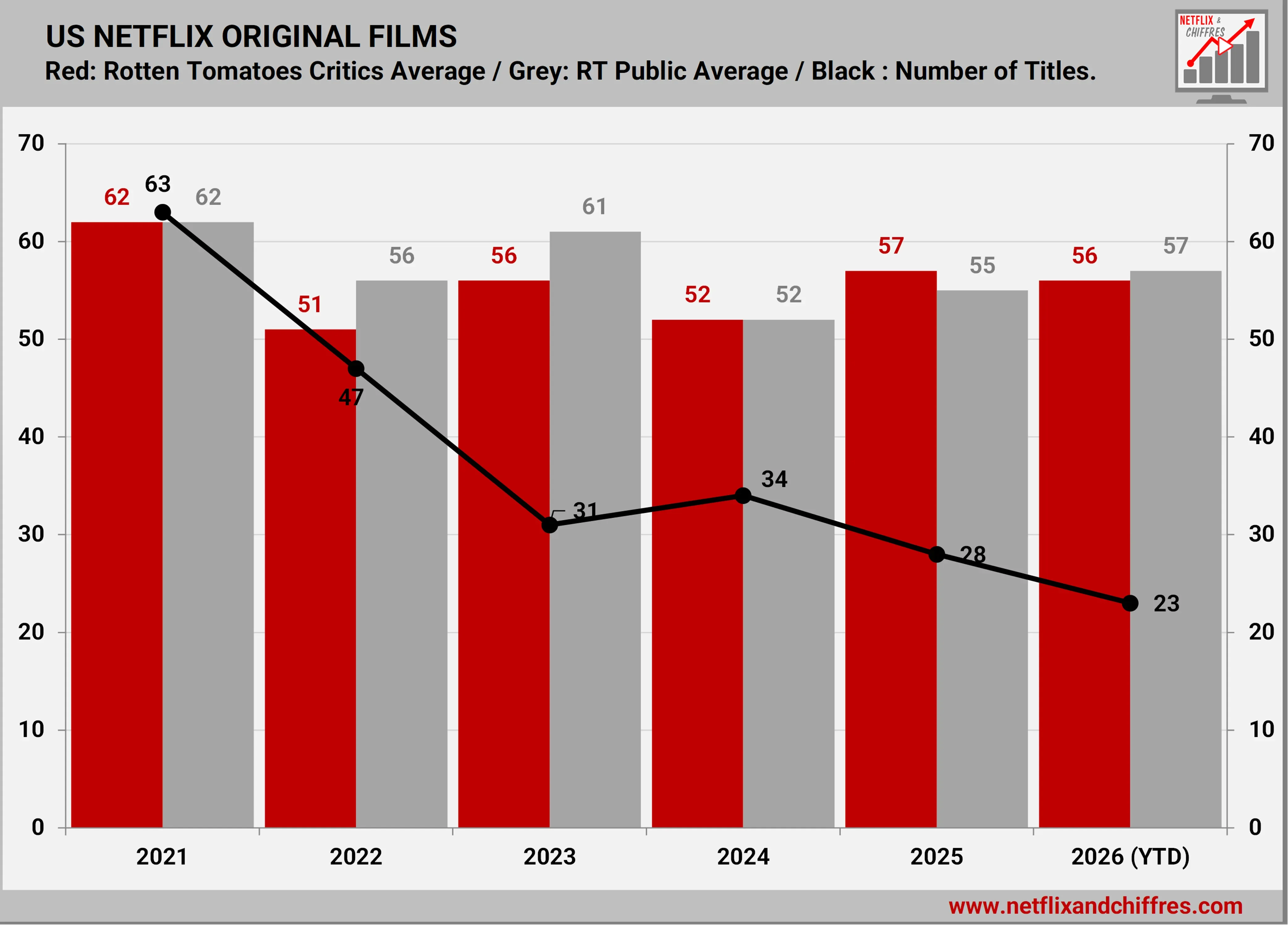
Netflix released 63 US films in 2021. It has released 23 so far in 2026, with the annual total expected to rise only a little above 30 after the holiday slate. That is a steep drop in output, while critic and audience scores have not climbed enough to suggest that cutting the slate reliably improved reception. Scores have edged up in the past two years, but they remain below the 2021 peak.
Critical acclaim also appears to be a weak guide to which films attract the largest audiences. Among Netflix’s 20 most-watched films, ranked by views in their first 91 days, critics’ scores average 60%, while audience scores average 68%.
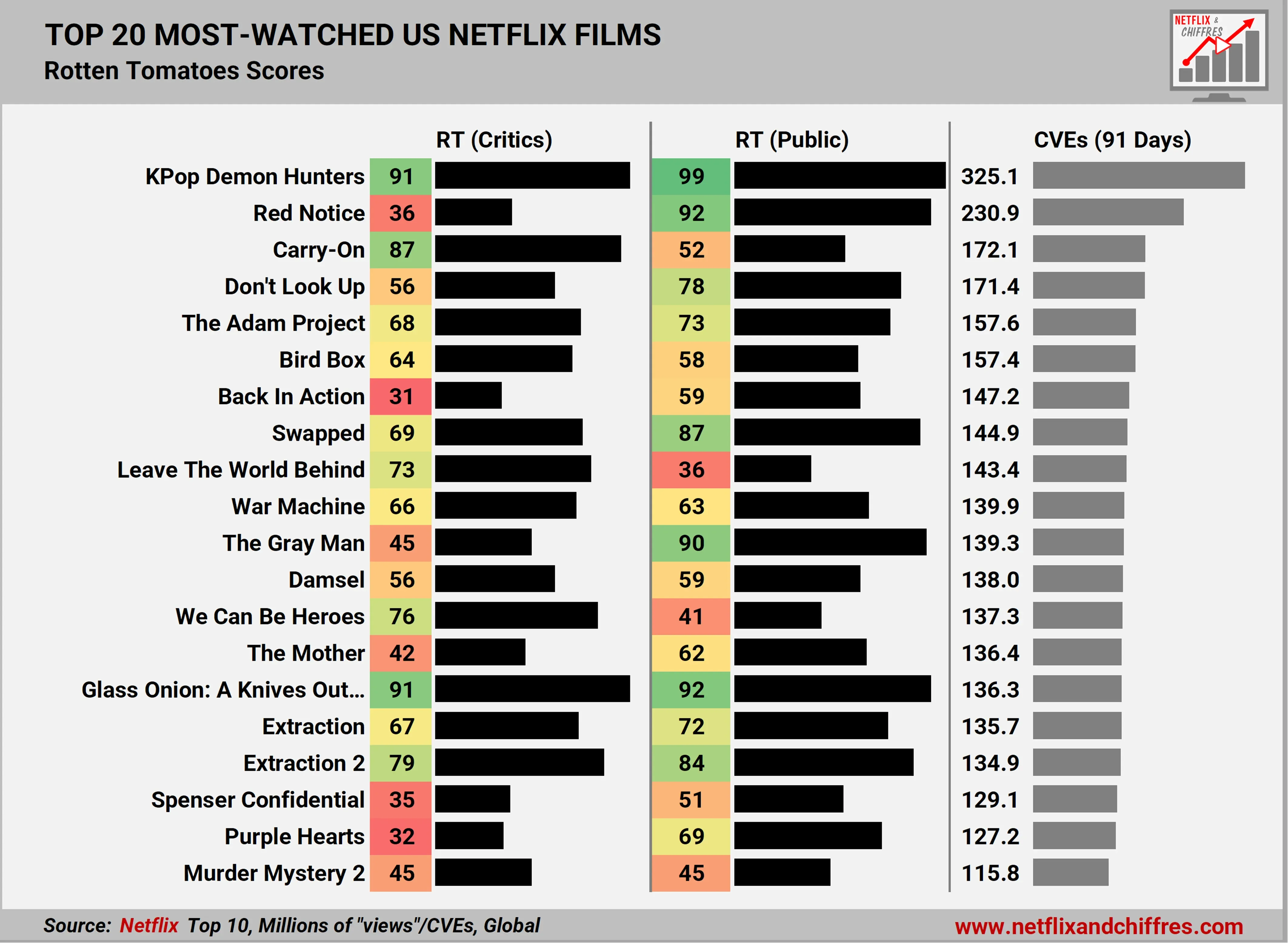
KPop Demon Hunters found favor with critics and audiences alike, but it isn’t the only model for a hit. Red Notice, the list’s second-ranked film, has a 92% audience score despite a much lower critics’ score. Its star power and spectacle offer a plausible explanation for its reach. Netflix’s “Two Thumbs Up” feature reflects the service’s emphasis on what subscribers enjoy, but the rankings point to a broader lesson: strong critic reviews don’t guarantee high viewing.
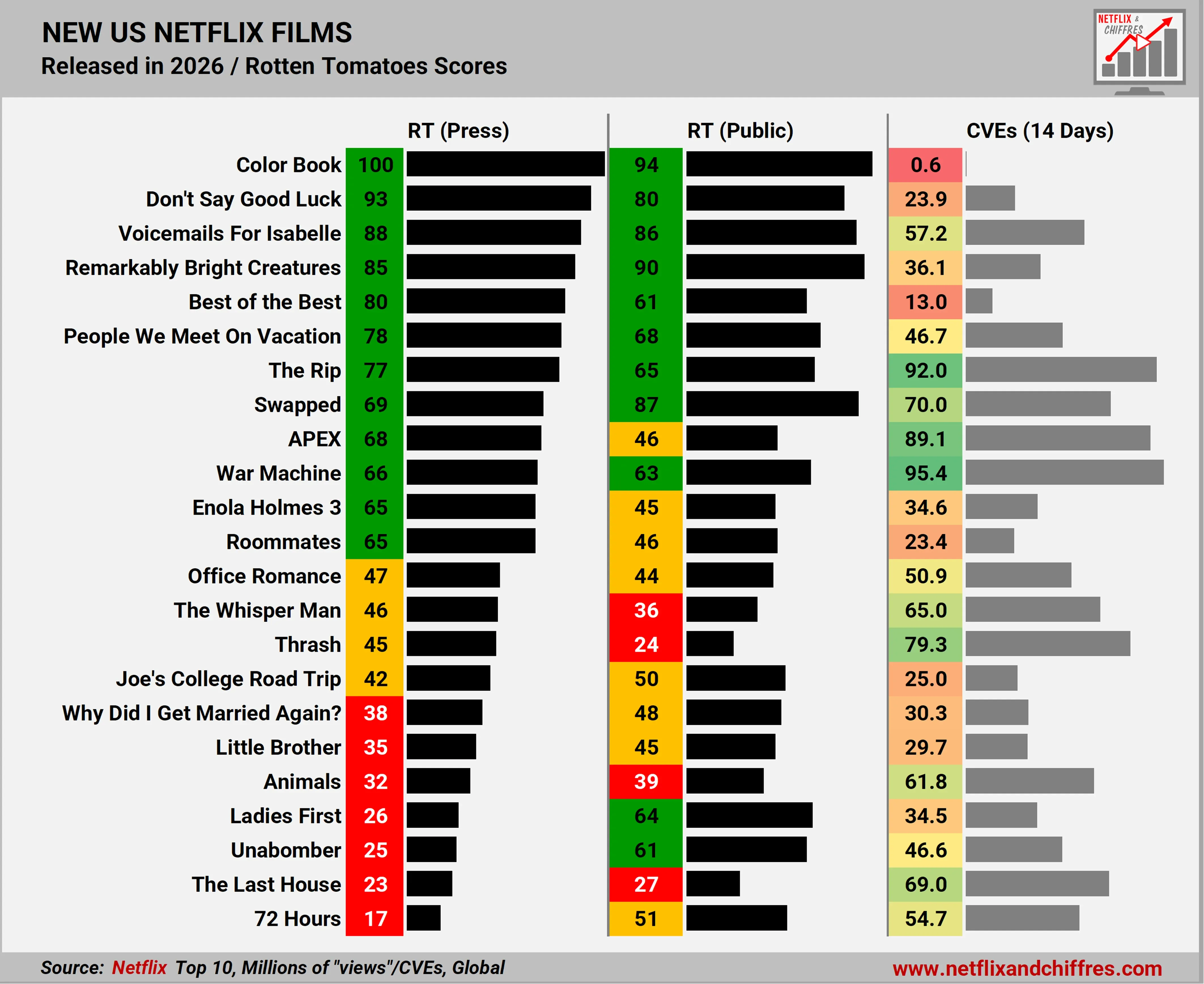
Color Book, described as the year’s critical standout, was among Netflix’s least-watched releases during its first 14 days. Across the titles examined, critical reception, audience scores and viewing figures don’t move in lockstep. A film that succeeds on all three measures is a valuable outcome, but the engagement debate turns most directly on viewing.
Theatrical releases are a limited engagement fix
Wide theatrical releases are often proposed as a way to earn new revenue and build a larger audience for a film before it reaches streaming. The second claim is less convincing for Netflix’s engagement goals. Films that arrive on the service after a cinema run may have lost some of the freshness that helps drive an immediate streaming launch.
Netflix co-CEO Ted Sarandos has pointed to family and animated films as exceptions: these can attract substantial viewing and repeat plays. That helps explain plans for a theatrical release of the next Narnia and an animated Charlie and the Chocolate Factory film at the end of 2027, as well as the possibility of a cinema run for KPop Demon Hunters 2.
This year’s 20 most-watched new streaming films in the US offers some support for that selective approach. Eight of the films had theatrical releases, and five of those are animated. The three live-action theatrical films drew fewer views than originals from Netflix or Amazon Prime.
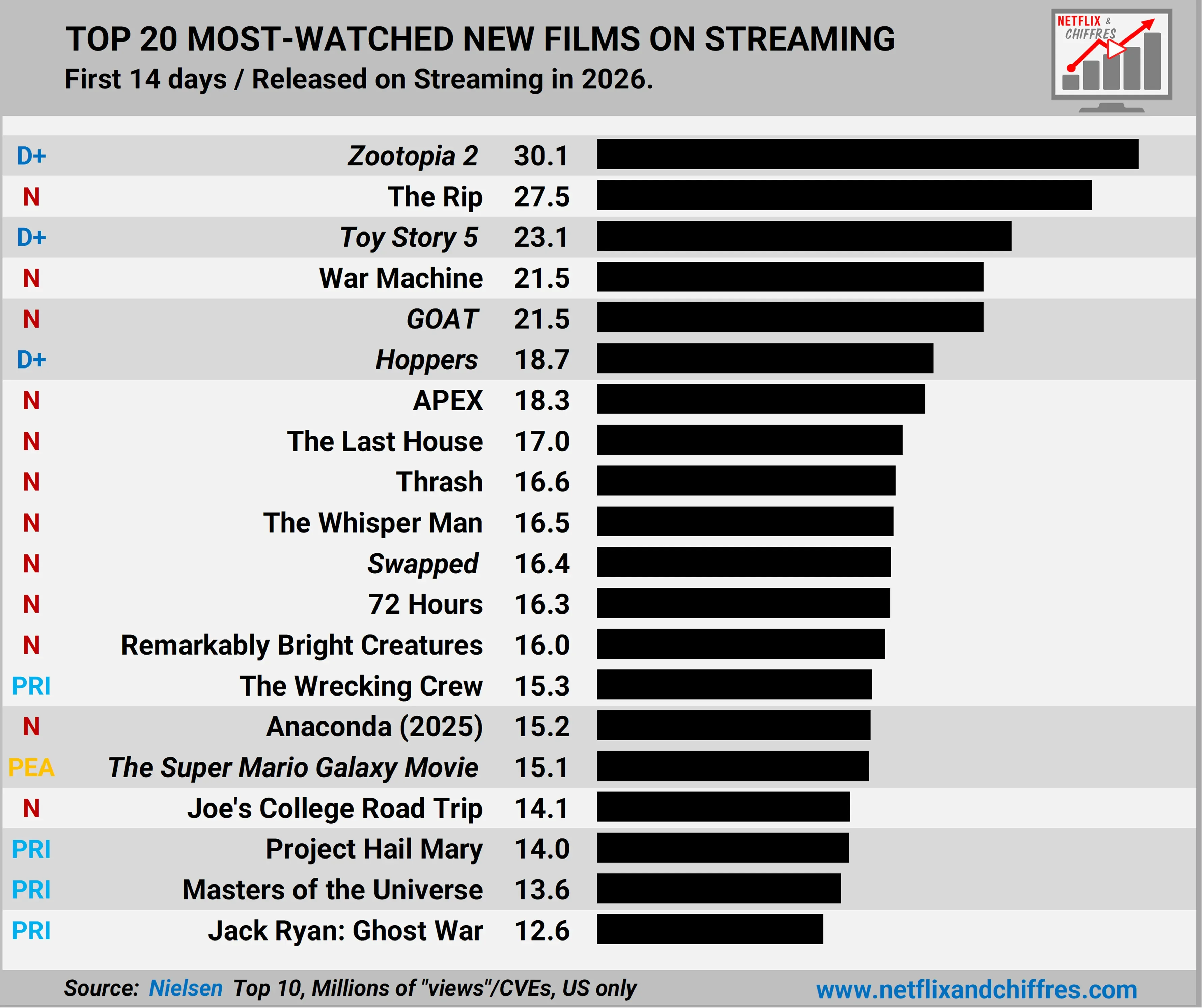
The timing of a release matters. A new animated film that launches directly on streaming could command more attention than the same title arriving after a 45-day theatrical window. Existing Disney and Pixar films may rank highly, but their viewing levels are below those of newly launched Pixar originals, according to the comparison cited here. A cinema run can build a film’s profile, but it can also shift some of the viewing that Netflix wants toward an earlier window.
The box office also looks too small and unpredictable to transform Netflix’s finances. US theaters are projected to approach $10 billion in ticket sales this year, with roughly $5 billion going to distributors. Even the implausible scenario in which Netflix captured every US ticket sale would add about 10% to annual revenue; putting its entire slate in theaters would bring in far less.
For context, Universal reported $1.089 billion in worldwide theatrical revenue in the first half of the year, Paramount $290 million and Sony $180 million. Those three studios, the only ones cited here as disclosing theatrical revenue, totaled about $1.5 billion. Netflix reported $24.8 billion in revenue and $8.6 billion in profit over the same period. The box office may provide a useful outlet for selected films, but it is unlikely to alter the company’s financial picture on its own.
Theater performance is volatile, too. After a record year in 2025, Warner Bros. Discovery’s 2026 slate was reportedly on track for a cumulative loss of $800 million, according to Page Six. Netflix’s business has been built around a different kind of predictability. Broad theatrical distribution would expose more titles to opening-weekend judgments without guaranteeing a corresponding lift in streaming engagement.
Weekly episodes stretch attention; they don’t create it
When a returning show draws fewer viewers in its second season, calls for weekly releases often follow. Spreading episodes over time can keep a conversation alive longer, but that doesn’t necessarily add viewing. The binge model makes it easy for a viewer to continue directly to the next episode; weekly scheduling instead asks the audience to return on a set cadence.
The release strategies across streaming services are also less uniform than the debate suggests. Netflix and Peacock continue to use full-season drops for major scripted shows. Prime Video often releases a first season all at once, then uses weekly episodes for established franchises. Disney+ has tried both approaches, including a binge release for Wonder Man and shorter multi-episode weekly batches for titles such as Visionquest and season three of Percy Jackson. Paramount+ has also tested binge releases this year.
That experimentation doesn’t make weekly scheduling an engagement engine by itself. HBO Max and Apple TV+ rely heavily on weekly releases, yet they don’t dominate the monthly Nielsen Gauge share. A weekly rollout can extend an existing audience’s attention across more weeks; it can’t guarantee that more people will watch a series in total. Shorter waits between seasons might help some middling shows retain viewers, but that’s a different question from whether a weekly schedule would fix Netflix’s broader viewing trend.
For a deeper examination of the relationship between season gaps and viewership, see this analysis.
Netflix may need more reasons to open the app
Former Netflix CEO Reed Hastings offered a compact version of the case for expanding the slate in a recent podcast appearance with Kara Swisher:
“I think the strategy is doing more and better television shows, more and better movies. The core brand property is about being thrilling. We realized, it took a long time, that we could be distrusted, we could be disliked, but we can never be boring, OK? That the essence of an entertainment brand is to be thrilling.”
The pairing of “more” with “better” is the point. Netflix’s US film output has fallen from 63 releases in 2021 to 23 so far in 2026, and its cadence has shifted from roughly one American film a week to one or two a month at most. Restoring some volume could create more occasions for subscribers to return, increase the odds of finding a breakout title and give the company room to test formats such as the choose-your-own-order series Kaleidoscope or interactive film Choose Love.
More releases won’t mean every title succeeds, and the cost would be substantial. But a smaller slate also carries a cost: fewer launches create fewer reasons to check the service week to week, while leaving Netflix fewer chances to produce a hit. With 325 million subscribers and a potential audience approaching one billion users, a single major US series and film each month may not sustain the level of viewing the service needs.
Netflix cut spending after a difficult market reaction in 2022, when it reported its first net subscriber loss—200,000 in the first quarter, largely attributed to its withdrawal from Russia. The correction followed months of concern about how content spending translated into revenue growth. Since then, “less but better” has shaped the production conversation, but the reduced slate has not resolved the engagement question.
That leaves Netflix with a more specific strategic choice: how much content spending can it sustain if growth slows? The alternative is to keep the current volume while viewing hours remain nearly flat. If Netflix wants subscribers to spend more time on the service, its next slate may need to give them more chances to find something worth pressing play on.