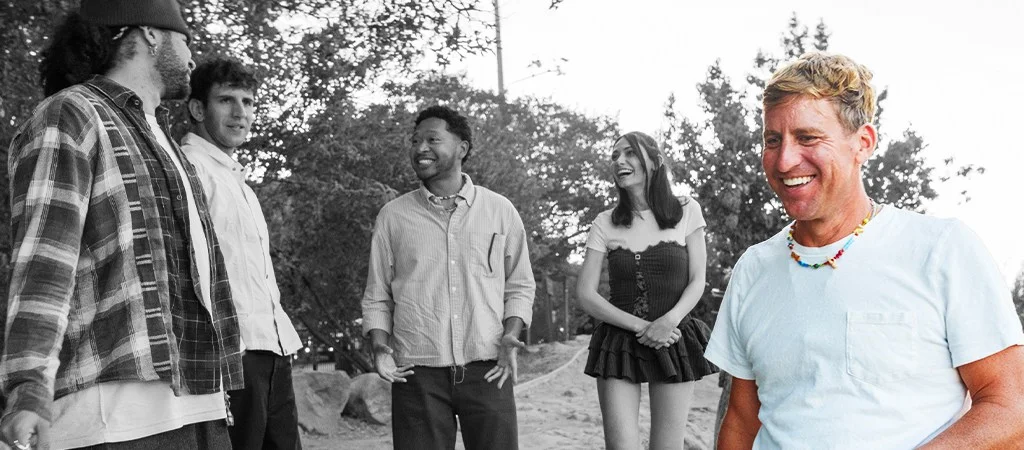
Creative careers often hinge on knowledge that can’t be bought: how to make better work, find an audience and keep faith with a vision before anyone else can see where it leads. That idea sits at the center of UPROXX’s final The Next Gear workbook, shaped by creative director Stephen Bramucci’s observations during conversations with Grammy-nominated DJ, producer and songwriter Illenium.
The series, created with Toyota, brought three emerging artists—DJ and producer St. Mary, stylist and designer Toreno Winn, and singer, songwriter and producer Otis Kane—into the all-electric C-HR for a ride-along with Illenium. Bramucci developed the concept around a simple question: what can an established creative offer someone starting out that money can’t provide?

His answer was wisdom: experience that can help a young artist make decisions and build a lasting career. This workbook distills the patterns Bramucci saw across the drives into exercises for creators at any stage. You don’t need a tour, a team or a finished release to use them. The prompts are designed to turn reflection into a next step.
Find the knowledge money can’t buy
“It started with the idea of what is the most valuable resource a young creative can possibly have? The only thing more valuable than money is wisdom — and wisdom can help them make exponentially more, and support their careers exponentially more… Everyone made every second of the time they had with Illenium their own. Their own shift in the front seat.” — Stephen Bramucci
WORKSHEET 1.1 — WHAT MONEY CAN’T BUY
Write down what’s holding up your work. For each challenge, ask whether money could solve it. If the answer is no, identify someone who has already dealt with the same problem—and decide whether you’ve asked for their perspective.
| What I'm stuck on | Would money fix it? (Y/N) | Who already knows this | Have I asked? (Y/N) |
|---|---|---|---|
Which challenge deserves an hour of someone’s time?
______________________________
What question would start that conversation?
______________________________
What could I show them to give the question context?
______________________________
What would I like to learn about their experience?
______________________________
What’s the smallest way to reach them this month: email, DM, call or comment?
______________________________
Balance the work, the audience and your point of view
“What really moves the needle for any artist is a balance of sincere care for your craft, care and high regard for your audience, and care for your own POV and your own vision.” — Stephen Bramucci
WORKSHEET 2.1 — SCORE THE THREE
Rate each area from 1 to 5 based on the past month. Give yourself credit only when you can point to a specific action.
| The care | What I did in the last month that proves it | 1–5 |
|---|---|---|
| Craft | ||
| Audience | ||
| My own POV |
Which area scored lowest, and what’s behind that?
______________________________
If I change nothing for a year, what happens?
______________________________
What’s one adjustment I can make this week?
______________________________
WORKSHEET 2.2 — YOUR OWN PRISM
“Illenium never tried to share anything that was beyond him. He shared things as he sees them through his personal POV and prism, and hoped our three emerging talents would find resonance in it. I think they all really did.” — Stephen Bramucci
List the subjects people ask you about or hear you discuss. Note whether you’ve experienced each one firsthand, then identify what your perspective adds.
| The topic | Have I lived this? (Y/N) | The part that's only mine to say |
|---|---|---|
What advice do I repeat without having made it my own?
______________________________
Where do I claim expertise I haven’t earned?
______________________________
What can I say from experience that no one else can say in quite the same way?
______________________________
Build belief and make your goals visible
“Illenium told stories throughout the day about how he always had to believe in himself very much first and foremost, and how he magnetized to people who believed in him, and how he has stuck with them in the years since.” — Stephen Bramucci
WORKSHEET 3.1 — THE BELIEF THAT COMES FIRST
Start with your own conviction. Answer the first prompt before considering who else supports the work.
What do I believe about my work, even though I can’t prove it yet?
______________________________
What evidence would make me reconsider that belief?
______________________________
Who believes in the work now, and how did they find me?
______________________________
How have I stayed connected to the people who backed me early?
______________________________
WORKSHEET 3.2 — THE GOALS LEDGER
“These are people who have clear goals, who feel like they understand their mission.” — Stephen Bramucci
Record active goals and abandoned ones, along with the date each began. A goal you dropped may have been wrong for you—or it may have slipped away during a difficult stretch and never been reconsidered.
| The goal | When I set it | Live or dropped? | What's moved on it, or why I dropped it |
|---|---|---|---|
Which goal gets the most talk and the least action?
______________________________
Which goal belongs to someone else’s expectations?
______________________________
Which dropped goal deserves another try, and what’s the first move?
______________________________
Which dropped goal can I release deliberately?
______________________________
WORKSHEET 3.3 — THREE, FIVE, SEVEN
“They felt like advice and wisdom from Illenium helped them get to that next gear, that next chamber they’re hoping to unlock. It feels like an opportunity that came to them as a way to amplify the next era of their careers.” — Stephen Bramucci
Begin with the seven-year view, then work back through five years to three. Describe the state of your work, your own circumstances and what you hope people recognize you for at each point.
| Horizon | Where the work is | Where I am | What I'm known for |
|---|---|---|---|
| 7 years | |||
| 5 years | |||
| 3 years |
My seven-year direction, in one sentence
______________________________
My five-year direction, in one sentence
______________________________
My three-year direction, in one sentence
______________________________
Which vision feels real to me now?
______________________________
What must I begin this quarter to make the seven-year view possible?
______________________________
The workbook’s practical value is in the sequence: identify where experience can help, measure the care behind your work, clarify what only your perspective can offer, then connect long-range ambition to an action this quarter. That’s a useful way to turn a mentor’s advice into a working plan.