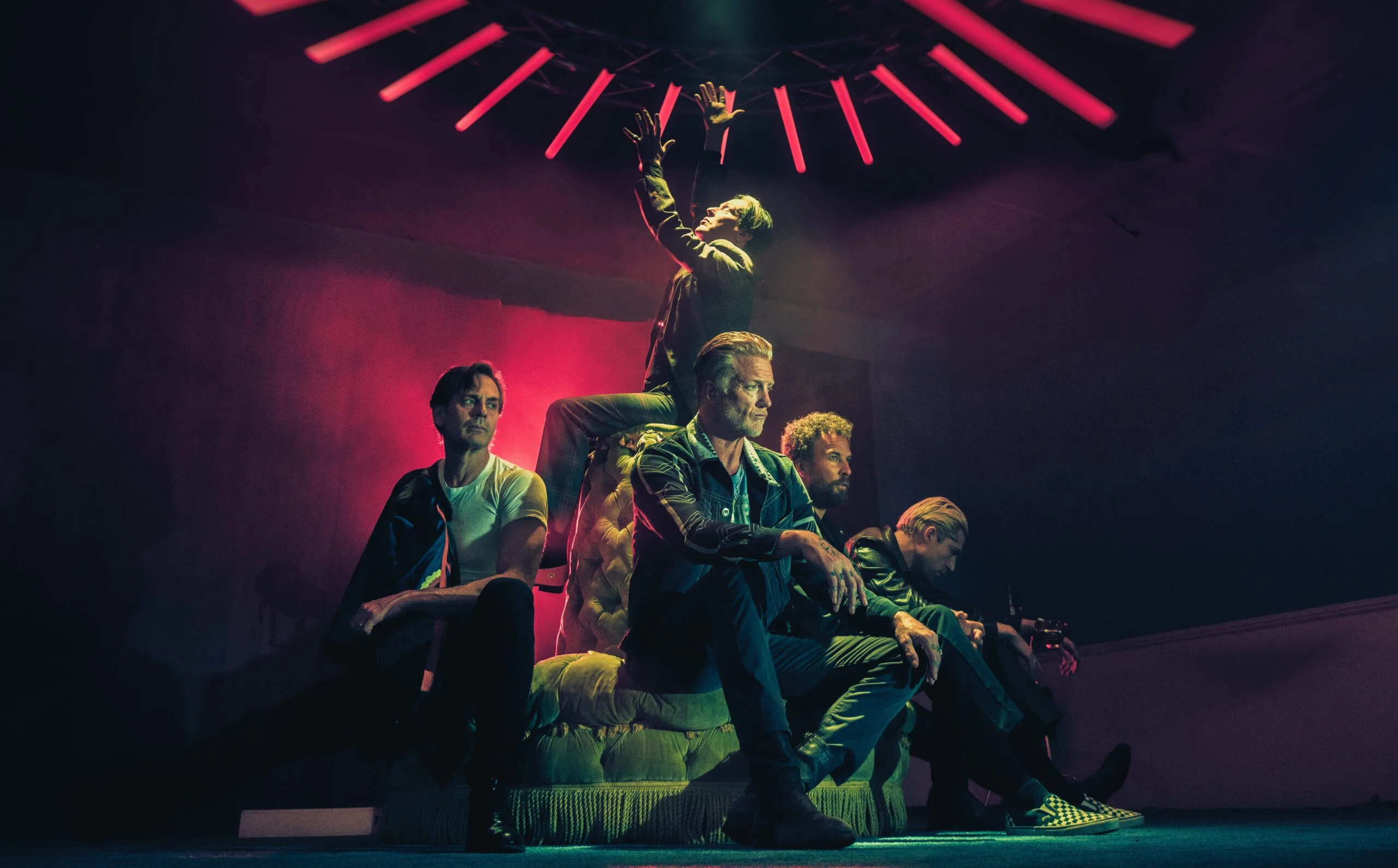
Josh Homme has never treated perfection as a destination. On Perfecth, Queens of the Stone Age make that skepticism the point: the title turns “perfect” into a dark joke about feeling fine while drifting toward disaster.
The album, due October 30 on Matador, follows 2023’s In Times New Roman…, where Homme turned life’s harshness into music as sharp-edged as the title. This time, at 53, he’s more willing to speak plainly. That shift doesn’t make the songs timid. They range from the uneasy ambient opening of “It’s Only Love” to the orchestral prank of “Where the Goth Girls At?” and the Beatles-like directness of “From the Cliff.” The band also leaves in the rough spots: missed turns and imperfect playing become part of the record’s human feel.
Love runs through the album in its many contradictory forms: a source of rescue, hope, heartbreak, and even a reason to question whether life is worth continuing. Some songs reach back to the early 2000s; others came from 2021, when Homme was in the depths of heartbreak. Together, they take on mortality, fatherhood, and the freedom of saying what he means without hiding behind abstraction.
The songs arrived after a punishing period that included recording a long-imagined live album in Paris’s Catacombs, a cancer diagnosis, and a bitter custody dispute with his ex-wife, Brody Dalle. Homme also found his way back to the people around him: bandmates Troy Van Leeuwen, Michael Shuman, Dean Fertita, and Jon Theodore. The current Queens lineup has spent years building its own volatile chemistry while Homme has had to confront how little any of us can control.
SPIN spoke with Homme in New York during a day off from Queens’ stadium tour with Foo Fighters. Dave Grohl, the band’s frontman, has been Homme’s friend and collaborator since their paths crossed decades ago. The idea Homme returns to is simple: getting everything right isn’t the goal. Paying attention while you still can is.
More from Spin:
- Update: System Of A Down Adds Fourth Rose Bowl Show
- Flaming Lips ‘Throb’ On Third Man Debut
- Boyz II Men Go Country With New Record Deal
Risk, friendship, and the turn toward directness
You saw Queens with Dave Grohl on drums at the Songs for the Deaf release show at Bowery Ballroom in New York in May 2002. Does that night stay with you?
Homme remembers it as a blast, and as something that could never last. Everyone involved, he says, was intensely themselves; it was like watching dynamite dance with matches. But permanence wasn’t the measure. What mattered was taking the risk and letting the moment happen.
When bassist and vocalist Nick Oliveri left in 2004, you spoke with Homme in what may have been his only interview about the split at the time. What was that period like?
Homme says he tried to handle it with restraint because he didn’t want to tear down a friend. Outsiders, he feels, didn’t understand what had happened or how difficult it is to fire someone you love. It was neither pleasant nor easy, and he thinks the people passing judgment should try doing it themselves.
The band was becoming much more visible after Songs for the Deaf. Did that timing complicate things?
Success, Homme says, comes without useful instructions. Every situation demands its own response, especially when the attention arrives unexpectedly. Queens had never set out to court the mainstream, so when it did, working through the consequences was complicated.
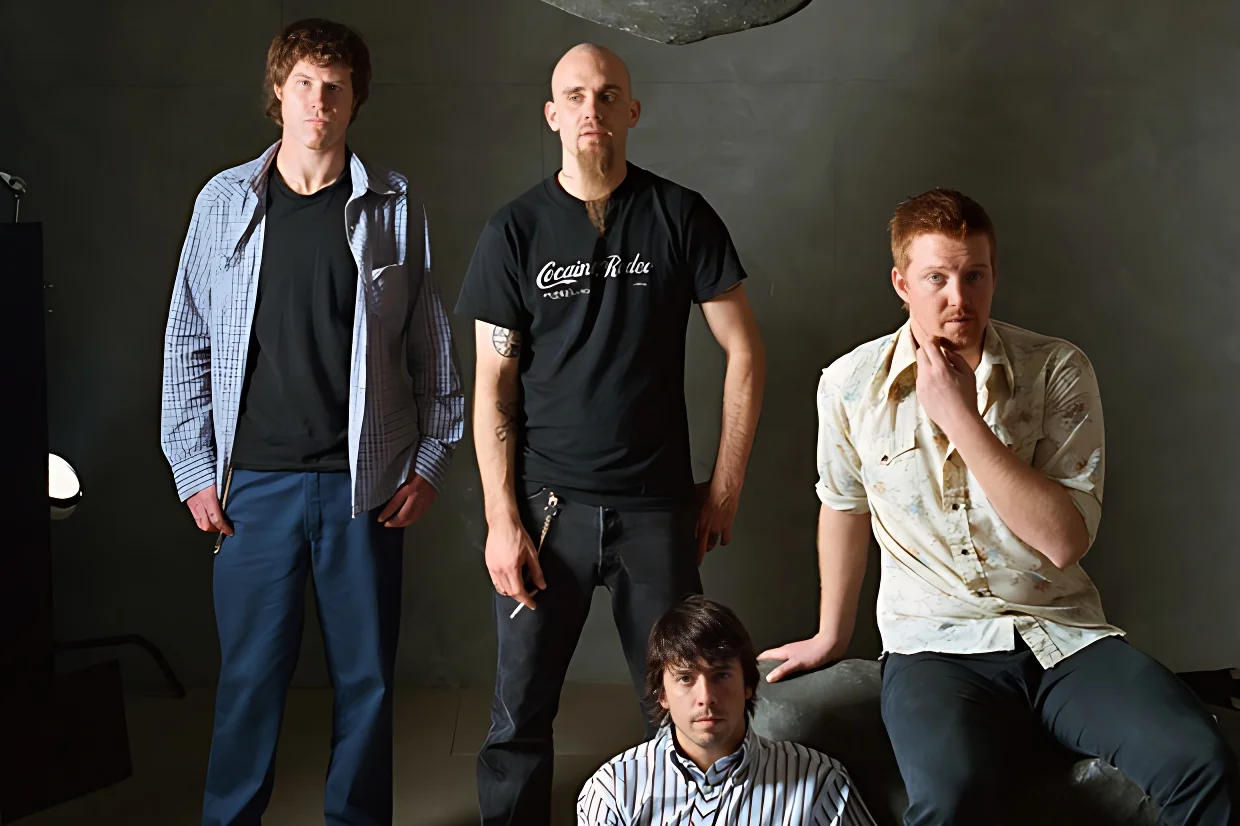
After the Catacombs project, what did you imagine Queens’ music might become?
Homme says the people who manage the Catacombs tried to discourage the band by pointing out that they couldn’t plug anything in. He took that obstacle as a reason to romanticize the idea: if they ever played there, he thought, it could mark the start of a third act.
Early in a career, he says, the challenge is keeping up with inspiration. Later, when that rush changes, abstraction can become a way to avoid admitting what’s happening. At 53, after everything he’s lived through, he doesn’t feel the need to hide. He points out that gentler songs have appeared on earlier records all along: “I Never Came” and “Long Slow Goodbye” on 2005’s Lullabies to Paralyze, and “Suture Up Your Future” on 2007’s Era Vulgaris. He’d often buried songs like those near the end of an album because he was afraid to put them up front.
Some of Perfecth was written in 2021, when Homme was heartbroken and questioning whether he wanted to go on. Love, he says, can pull someone out of the tar and offer a way back to hope; it can also bring a person close to madness. He’s made enough mistakes to stop worrying about whether listeners call the album “soft.” His measure is whether it accurately reflects his life. Taking that chance, he says, is how this record could stand among his best.
The opener, “It’s Only Love,” brings ambient noise into a Queens record. It feels like the right entry point for Perfecth.
Homme connects the title to the gallows humor of 2013’s …Like Clockwork: you’re headed to hell in a rowboat and call the trip perfect. That joke works when you’re with someone; alone, it doesn’t. He says the tension between company and solitude is a distinctly current concern. Lots of people find themselves alone without knowing what to do, and he wanted to explore that as a songwriter. In that sense, he calls this one of Queens’ most universal records: it’s about love, full stop.
Where did you record the train sound?
At Sound City, in a bleak stretch of Los Angeles’s San Fernando Valley. The studio sits near industrial train tracks and a Budweiser plant, with people living alongside the tracks. Homme wanted the sound to carry the roughness of the setting, because an unpleasant feeling should sound unpleasant. The band recorded close to the train, close enough that its operator appeared to be panicking and shouting for them to move. Homme says he enjoys approaching feelings that way.
The song itself is short and spare. Mark Lanegan had once asked to take it while they were writing together, at least 15 or 16 years ago. Homme contrasts his own approach with Jack White’s stated preference for writing through composites and other people so he doesn’t have to repeatedly sing about personal pain. Homme understands the appeal, but says he doesn’t know how to write for Queens from someone else’s point of view.
Does “Insignificant Other” go back to the In Times New Roman… sessions?
Homme had the musical parts before that album was finished. Given what he was going through, he could have made In Times New Roman… a record of self-pity. Instead, he felt it was better to write about life’s brutality and jagged edges, and let the album speak more broadly about the world. He knew that choice would create enough distance for Perfecth to exist.
“Insignificant” came together around midnight on the final day of recording. Homme asked the band to sketch one more idea, then called out the arrangement as they played. The setup forced the musicians to watch and listen to one another. The tempos shifted; notes went out of tune; mistakes stayed in. For Homme, that roughness sounded human. The album grew from the idea that some things don’t need to be corrected or covered up. In a culture full of fixes, he wanted the band to accept what happened and play like people.
Has Queens ever sounded this much like the Rolling Stones?
Homme agrees. The band kept returning to Tom Petty’s “You Got Lucky” and its late-night feeling: low lights, a restrained volume, musicians simply playing. The Rolling Stones’ “Miss You” has a similar mood, and that sensibility stayed with them through the record.
“Where the Goth Girls At?” sets an orchestra against a riff that sounds almost meatheaded.
Homme says the contrast grew out of a run of experiments. While working with Iggy Pop, he wondered why Iggy’s screams couldn’t be loud enough to overwhelm the mix. On Villains, he played with the idea of making a record so quiet at first that listeners would turn up the stereo before a sudden blast startled them. For In Times New Roman…, he imagined an orchestra in the next car playing the same music, hating Queens, then crashing into them and taking over.
On this song, the riff struck him as deliberately dumb. So, at the chorus, the orchestra takes over instead of the guitars and keyboards. He likes following an extreme idea far enough to see what it produces, even if some listeners never notice the choices. The records are for him; he still hopes other people enjoy them.
Palm Springs, heartbreak, and the plainspoken song
Is “dying makes you feel alive” about growing up in Palm Springs?
Homme says it is. When he was 13, the mall was the place to go.
Town Center in Palm Desert?
Yes. The interviewer says their grandparents lived in Rancho Mirage for much of their life.
Homme remembers Record Alley and JCPenney, along with three goth girls he knew, two of them Mexican. He calls Mexican goth “the gold standard.” At 13, he’d skateboard, eat ice cream, and smoke cigarettes, a combination that still feels nostalgic. He remembers elderly women in golf clothes getting dramatic makeup from the goth girls, and seeing the two generations as versions of one another: you grow into the person you once were.
The song’s young love and fascination come from a feeling that there was nothing for him in town, except these girls, who seemed to know something. Homme had leather and a mohawk; in a small town, he says, dressing that way was a declaration against the place. It came at a cost. The goth girls, in their own way, made the same kind of statement, and he saw them as strong.
“Mono” sounds like it might have been written in a burst, then screamed without much explanation.
Homme laughs. He thinks it also dates to 2021, when he was working in the room above his garage. The recording catches heartbreak as it happens: he stops singing when he breaks down, and the performance slips out of tune and time. He wanted it to sound as painful as the feeling itself. He knows Jack White takes another approach to personal material, but Homme would rather sing directly about difficult emotions than pretend they aren’t there.
“From the Cliff” brings in a touch of the Beatles’ White Album. Queens hasn’t often sounded so acoustic or built for a foot stomp.
Homme says he’s wanted to play a song like that for years. Shuman wrote the music in New Orleans, playing the riff in the control room. Homme describes the moment as similar to working in Eagles of Death Metal, where Jesse Hughes brings in riffs and one idea suddenly opens up possibilities. He wants the band members to bring in whatever they have; when something catches his ear, they’ll play it.
He’d also long wanted to write a love song as simple as the Beatles’ “I Want to Hold Your Hand.” To him, “From the Cliff” is naive and pure. He isn’t afraid to say something plain without dressing it in poetry; sometimes the directness makes it poetic. Homme says he can count on one hand the times every lyric arrived at once, with “Go With the Flow” among them.
He recalls Johnny Cash saying he wasn’t music’s creator, but its deliverer. Homme likens his role to a butler waiting for the call so he can bring tea upstairs. Listen closely, he says, and you can hear that this album is real—and that it’s the best he can do.
You and Iggy Pop recorded “Sunday” for Post Pop Depression in 2016. What did you want your own version to do differently from his?
I’ll recast this as the article’s closing section, keeping the interview’s claims, names, song titles, embedded video, image, and link intact while reshaping the structure and adding only interpretation grounded in the fragment.Songs that found their shape
The clearest thread through these stories is trust: in a collaborator, in a song’s timing, and sometimes in the decision to stop forcing an answer. The album came together easily, the musician says, because it needed to feel “jiggly and bubbly” and seemed to sequence itself. “Sunday” nearly stayed in his own hands. The next morning in Joshua Tree, he told Iggy Pop he loved him and wanted to give him everything he had; he said he’d save the song for himself only if he ever needed it, and pointed to the path Iggy had already opened with “China Girl.”
The band was initially lukewarm about rerecording “China Girl.” They got a strong take, but he heard himself imitating Iggy. Then the arrangement clicked: he began hearing a ’70s French disco feel and circling countermelodies. He hoped the track would make the record. Once it was mixed, everyone was dancing.
That same instinct shaped “Easy Street.” Its lyrics rest on a wish: if one person finds a place called Easy Street, they’ll tell the other where it is; if the other finds it first, they’ll do the same. The song needed a female voice, so Nikki Lane joined him. He says working with Lane had helped him through a terrible period: she had asked him to work with her, pulled him up, and given him a chance. He describes her as strong, powerful, and firmly in charge. The duet let him try something new while keeping the song recognizably his.
Letting the song say enough
His account of “Phantom Limb” is more unusual. Each January, he says, he undertakes what he calls an interior exploration with drugs. He has been told he metabolizes drugs and medicines quickly, he says, and describes taking nine or 10 grams of mushrooms alongside pure MDMA and ketamine injections. This year’s lesson, in his telling, was to accept and let go. Being present matters, he says; parents can start by getting down to a child’s eye level.
“Phantom Limb” came together in a single session. After an experience that began at 8 a.m., he was driven to the studio at 3:30 p.m., while still feeling held by it. The others were waiting. He had memorized the line “no poets here to interfere,” which he recognizes as ironic given how poetic it sounds. The point, he explains, was to keep himself from dressing up a simple declaration of love with ornate language. Some words are hard enough to say plainly.
Alice in Chains also helped point the song toward its sound. He says he had listened to the band often, though as a younger, arrogant man he couldn’t admit he liked them. Now he singles out the harmonies, Layne Staley’s voice, and Jerry Cantrell’s disciplined guitar playing. “Phantom Limb” needed to be a rock song driven by acoustic guitar.
A closer that waited 25 years
“Run Away From the Mob,” the album’s closer, is about patience—and about recognizing when a song isn’t ready. The song is 25 years old, and its recording dates to 2013, he thinks. Dave Grohl once told him that not every song has to be his best. His answer was that any song might be. After finishing other material too early and sensing it could have been 20 percent better, he decided he wasn’t the person to finish this one yet.
The recording was already done; the lyrics and vocal approach were not. He would leave it alone, then occasionally hum it to see whether it had come into focus. He eventually understood it as a letter to his middle son: advice for the possibility that he might be gone and the world might fall apart. That gives the song its place at the album’s end. Its chord changes carry what he calls a “Hallelujah” quality, and, like the ending of “Made to Parade,” they feel uplifting, with hands outstretched. The sound offers optimism even though the lyrics don’t quite match it.
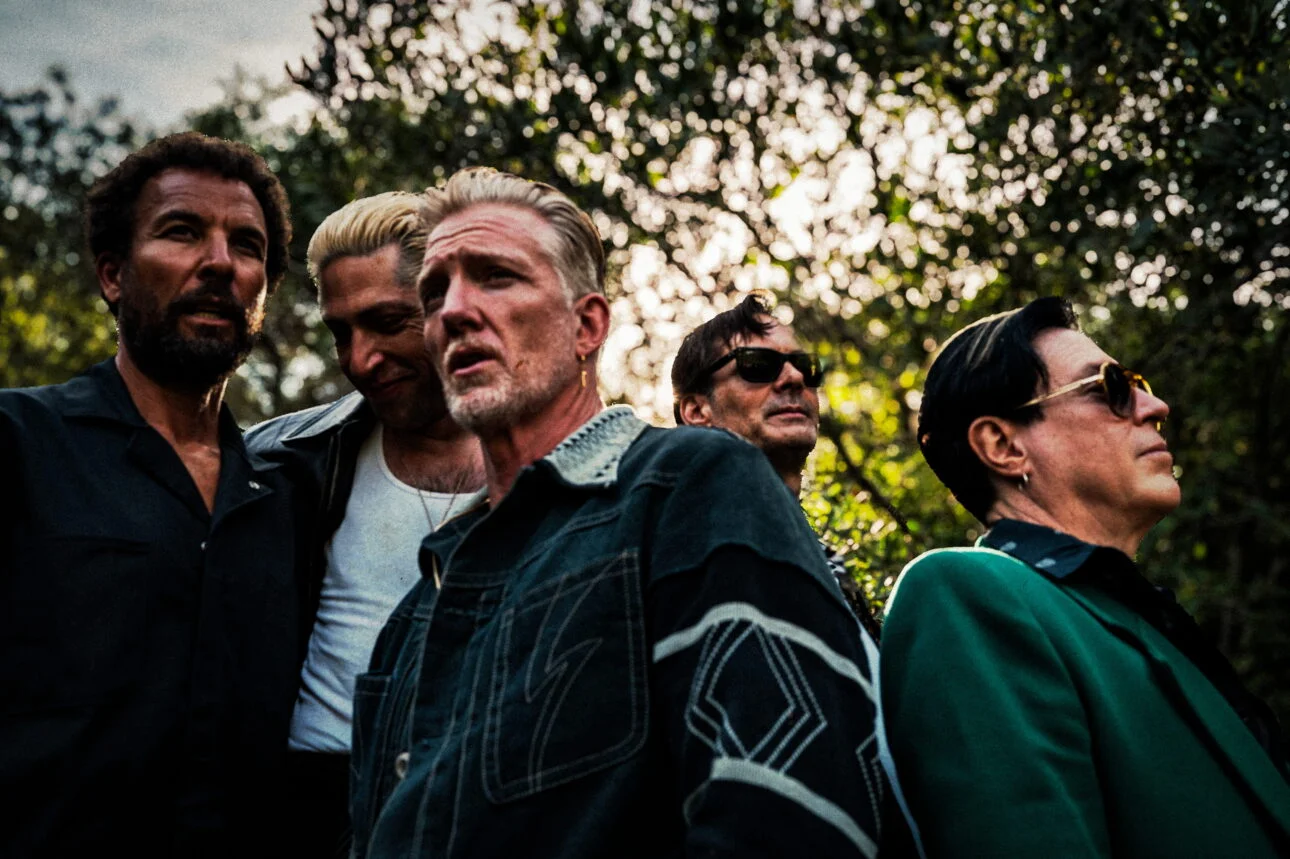
A record made at the right time
He sees Perfecth as arriving in the right place in the Queens of the Stone Age catalog, shaped by everything that came before it. He has been cocky, out of his mind, sturdy, dependable, and deeply undependable. The lesson he carries from recent years is simpler: listen well enough not to miss what the people he loves are saying.
That outlook, he says, is built into the record. It took everything to get here, and he’s proud that the result can be reduced to a plain instruction: make something you think is cool. He doesn’t see the band as participating in the mainstream, so the album isn’t a revolt against it either. Red carpets and stadiums aren’t what he’s focused on. The more telling idea is meeting people where they are, down on both knees.
One more lap with Them Crooked Vultures?
A reunion with Dave Grohl and John Paul Jones is at least being discussed. On tour, Grohl and the singer have days off between performances, and Grohl has been renting a car so the two can go exploring. They get breakfast together and spend long stretches talking as friends. Both understand how appealing it would be to take another lap with Them Crooked Vultures, but each has other jobs, and he says it isn’t his role to assemble the group. He sees Jones regularly and knows there’s interest. Making it happen, he suggests, is like jumping into double Dutch: the timing has to be right.
Their friendship has room for ordinary errands, too. In Ohio, they found Grohl’s grandmother’s burial plot and visited his boyhood home. Then came Grohl’s first trip to Bass Pro Shops, followed by a stop at a huge fireworks store where they were the only customers and spent a lot of money. They met when the singer was 19. After years of shared chaos, he says, the friendship means so much because few others could understand what they’ve been through.
That may be the most revealing ending here. The album’s songs turn on listening, patience, and saying what matters without getting in the way of it. The same values show up in the friendship that could, one day, bring Them Crooked Vultures back together.
See SPIN’s running list of the top 100 greatest rock stars of all time.