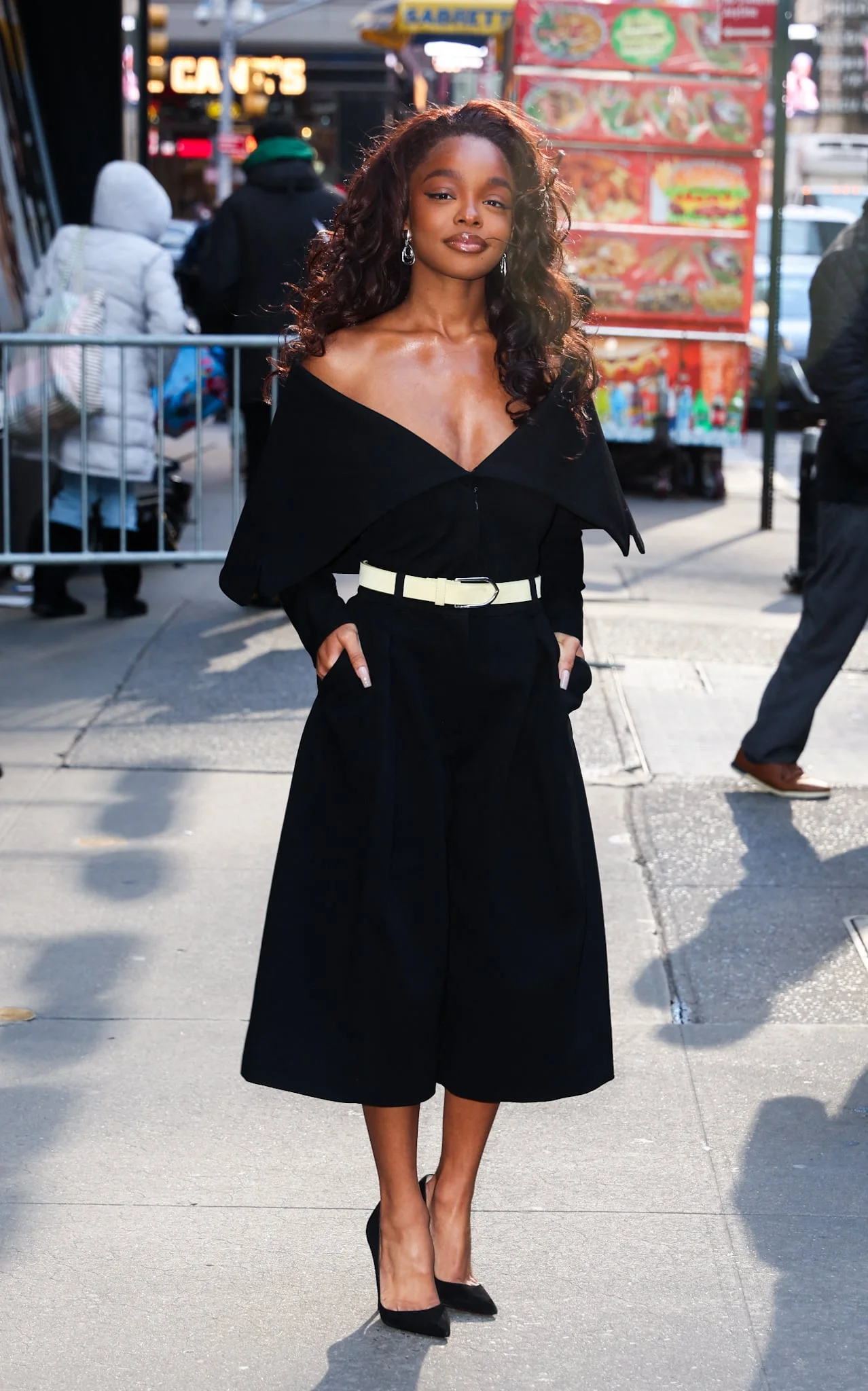
Marsai Martin’s latest burst of online attention says as much about how audiences track former child actors as it does about celebrity image scrutiny. A throwback video of the “Black-ish” star prompted renewed speculation about her body, while discussion of her work beyond acting received less attention. That imbalance is familiar: a celebrity’s appearance can become the easiest subject for a viral post to package, even when the person’s career and public profile are much broader.
The clip, reshared by a fan account on X, shows Martin in a beige crochet two-piece, dark sunglasses and gold jewelry, walking toward the camera in heels. She jokes that she’s auditioning to be a “GTA stripper” and plays up the performance with exaggerated hip movements. The video appears to have been recorded inside a home overlooking a pool, and its playful tone matters: the clip presents a deliberate performance, while some of the reaction treats it as evidence about Martin’s private choices or body.
Why the clip became a conversation about growing up
Martin became widely known at nine, playing Diane on “Black-ish.” Now 22, she’s spent years navigating the transition from child performer to adult actor in public view. The reaction to this clip shows how strongly an early role can shape the way viewers interpret someone years later: some commenters still associate her with the young character they watched on television. For those viewers, an adult image can feel like a sudden change even when the person has grown up in full view.
Others questioned why the discussion framed her as newly “grown.” One commenter objected to tying adulthood to revealing clothing, writing: “This is what people call grown. Grown because she is showing so much cleavage. State of society.” Some users said they hadn’t watched “Black-ish” and knew Martin only as an adult, making the debate about her age feel misplaced. Both reactions point to the same tension: an audience’s memory of a child star can linger, but it doesn’t define how every viewer sees that person now.
- This sizzling photoshoot convinced some fans that “she’s really become that girl.”
- Marsai Martin was already producing her own movie at 14 and shared advice for anyone chasing the same path.
Speculation about her body draws pushback
A separate X post asked, “Did she get breast implants?” The question drew more than 100 replies, splitting users between those who speculated about cosmetic work and those who said her figure could be natural. One commenter wrote, “A woman can naturally have perky t-ts”; another replied, “Them thangs be sitting. No implants.” Others called the conversation “weird” and criticized the focus on her body. The thread doesn’t establish anything about Martin’s choices; it shows how quickly online discussion can turn an unverified question into a debate people feel entitled to settle.
The same argument appeared under a TikTok Martin posted showing her outfit for Kimberly Blackwell’s inaugural “The Culture’s Coldest: Icon Honors” event. A commenter joked that she had “some new girls,” prompting another round of competing claims about whether her curves were natural. Here’s the thing: repeating a claim doesn’t make it better sourced. The post and its replies offer a snapshot of audience reaction, not evidence about whether Martin has had cosmetic work.
Martin steers attention elsewhere
Martin didn’t respond to the comments about her body. She replied instead to a fan who noticed that her younger sister, heard speaking in the video, sounded like Martin’s “Black-ish” character. Other commenters compared her with Beyoncé, Rihanna and Niecy Nash. Her choice to engage with a lighter observation doesn’t tell us what she thinks about the broader thread, but it does show that she can direct a moment of attention toward the parts of the post she wants to address.
That contrast points to a familiar pattern: a celebrity’s appearance can dominate the conversation even when their public work extends well beyond it. Martin’s career includes producing a film at 14, but her charitable work offers another measure of her impact. The numbers here are more substantial than a passing comment thread: they describe sustained activity, even if they don’t capture every effect of the work.
Foundation work draws support
The Marsai’s Way Foundation says it has reached more than 10,000 students through 64 initiatives and 36 global partners, and awarded over $200,000 in scholarships. The organization recently held its first luncheon, attended by hundreds of supporters. Those figures offer a clearer sense of the foundation’s stated reach than a viral clip can, though the article doesn’t provide detail on how each initiative or scholarship was delivered.
Martin shared a video recap on Instagram, where fans praised her accomplishments. The contrast is clear: speculation can travel quickly, but her foundation’s work offers a more lasting account of what she’s building. And this is the part most people overlook: visibility can draw attention to charitable work, but the work itself is measured through what an organization does for the people it serves.
What the attention says about her public image
Martin’s experience reflects a recurring challenge for performers who became famous young: audiences can keep an old image of them long after their careers have changed. Social platforms make that friction visible, because a single clip can place childhood memories, adult self-expression and speculation in the same thread. The loudest comments may travel furthest, but they’re a poor guide to the full shape of a career.
If you’re working in this space, the distinction between a celebrity’s own post and the audience’s interpretation of it matters. Martin’s clip is a joke and a performance; the claims about her body come from commenters. That boundary often gets blurred when reaction becomes the story. A revealing outfit, a familiar face, a debate. And yet, her work as a producer and the foundation’s reported activity point to a public identity that can’t be reduced to how strangers read a video.
The conversation may keep circling back to Martin’s appearance, especially for people who still see her through “Black-ish.” But her response, her creative history and the foundation’s stated reach all suggest that attention can also be redirected toward what she chooses to make and support. The online speculation is fleeting. The record of her work is still taking shape.